ES
The polishing pad gets all the attention, but it sits on a backer pad that quietly decides how it performs. A rigid backer keeps a flat pad flat; a flexible one lets the pad follow a curve. Get the backer wrong and even a good pad leaves swirls or misses the shape you are trying to finish.
What a backer pad does
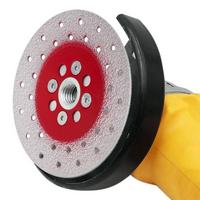
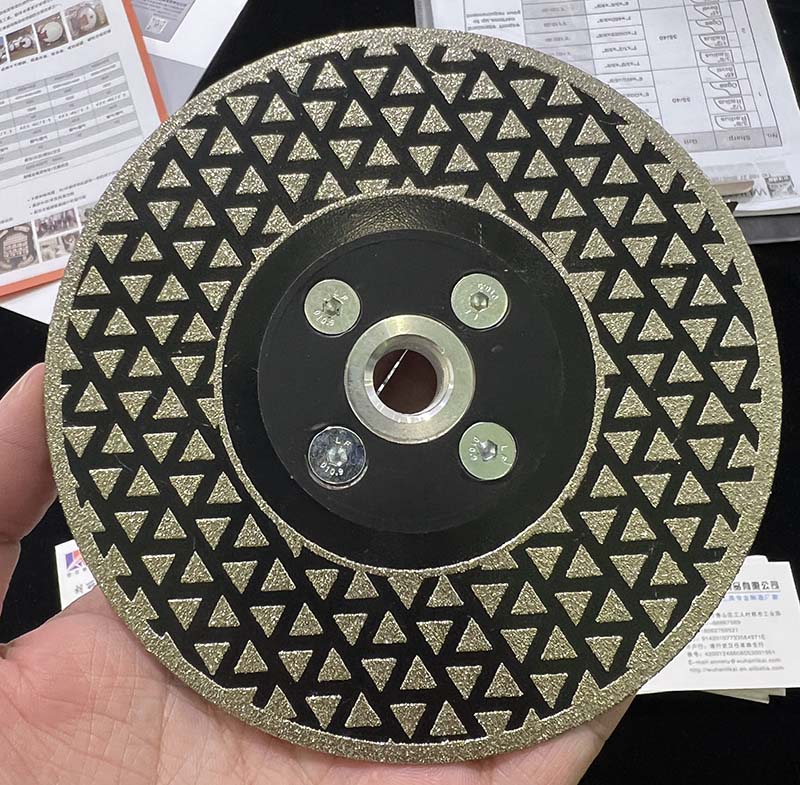
A backer pad is the interface between the polisher's spindle and the polishing pad. It carries a hook-and-loop (Velcro-style) face that grips the back of the pad, and a threaded centre that screws onto the tool. It has two jobs: hold the pad securely, and set how much the pad can conform to the surface. Both matter to the finish. The most common formats are a rigid backer pad with a hook and loop face for flat work and a softer pad for curves.
Rigid, semi-rigid and flexible backers
- Rigid (often aluminium): stays perfectly flat, so a flat pad on a flat surface produces an even finish. This is the default for countertops, floors and flat slabs.
- Semi-rigid (rubber or stiffer foam): a little give to cope with slightly uneven surfaces without losing flatness.
- Flexible: conforms to curves, mouldings and bullnoses, where a rigid backer would bridge the shape and miss the middle.
A rubber-backed backer sits between the two, giving controlled conformity without losing control on flat areas.
Matching the backer to the job
- Flat surfaces, high gloss: rigid backer, so the pad cannot tilt and leave swirls.
- Curved edges, mouldings: flexible backer that follows the shape.
- Uneven or textured stone: semi-rigid, to reach into the low spots without gouging the high ones.
- Large areas: a backer matched to the pad diameter so the full pad works, not just its middle.
Diameter and thread
The backer must match the polishing pad's diameter - a 100 mm pad on a 125 mm backer overhangs and tears, while a 125 mm pad on a 100 mm backer wastes its outer edge. The thread has to match the tool: M14 on most European polishers and grinders, 5/8-11 on many US-style machines. An adapter works but adds run-out, so a backer with the right thread is the better choice - see our notes on M14 vs 5/8-11 compatibility.
Looking after a backer pad
- Keep the hook-and-loop face clean; dust and slurry stop it gripping, and a pad that slips marks the stone.
- Replace the backer when the hook face stops holding a pad firmly.
- Check that the backer is flat and undamaged; a bent backer makes every pad run out of true.
- Do not over-tighten the thread or cross-thread it - a wobbling backer ruins the finish and the tool.
- Match speed to the backer and pad; running a rigid backer too fast overheats the pad.
Safety
Fit the backer securely before starting, and check it is still tight during a long run. Wear eye protection, a dust mask or respirator and hearing protection, keep water away from electrical connections on wet work and use an RCD or GFCI. Respect the tool's speed and the backer's rating, and follow the manufacturer's instructions. A backer that comes loose at speed throws the pad across the shop.
Backer pads in short
- The backer controls flatness and conformity - choose it for the surface.
- Rigid for flat, flexible for curves, semi-rigid for uneven stone.
- Match diameter and thread to pad and tool.
- Clean the hook face and replace a worn backer - browse the polishing tools range for backers and pads.