ES
Concrete floor preparation is judged by one question: will the coating stay down? The answer depends on what the surface looks like before the coating goes on - free of laitance, contamination and high spots, with a scratch profile the new layer can grip. Arrow segment grinding wheels exist to get a slab to that state quickly, and the shape of the segment is what makes them good at it.
Why the segment shape matters
An arrow or arrowhead segment tapers to a point at the leading edge rather than sitting as a flat block. That point concentrates pressure into a small contact area, so the wheel cuts into coatings and high spots instead of skidding over them. As the arrow wears back it stays pointed, which keeps the wheel aggressive through its working life rather than going blunt halfway through a floor.
Arrow segments are usually metal bond, because concrete is abrasive and unforgiving and a soft bond would be gone in minutes. A metal bond arrow segment wheel is the standard choice for this work.
What preparation actually removes
- Laitance: the weak, dusty top layer that forms as concrete cures. Leave it on and any coating bonds to dust.
- Coatings: epoxy, paint, sealers and adhesives that must come off before a new system goes on.
- High spots and unevenness: ridges and level variations that would show through a thin coating.
- Contamination: oil, curing compounds and dirt that block adhesion.
The aim is not a polished floor. It is an open, evenly scratched surface that gives the coating something to key into - usually described as a light to medium profile rather than a smooth finish.
Matching bond and grit to the job
Softer concrete needs a harder bond so the diamond is not lost too quickly; hard, dense concrete needs a softer bond so the matrix wears back and keeps exposing fresh diamond. The grip and grit size control the scratch pattern - coarser for heavy removal, finer for the final pass before coating. If the wheel polishes instead of cutting, the bond is too hard for the surface; if it wears away far too fast, it is too soft.
Working method
- Remove loose debris first so the wheel is not grinding over grit.
- Run overlapping passes in a steady pattern rather than dwelling in one spot - dwelling creates hollows.
- Keep the machine moving at a consistent speed so the whole floor gets the same profile.
- Check the surface as you go; once laitance and coating are gone, stop. Grinding past that point wastes diamond and creates a surface that is too smooth to bond.
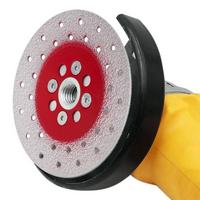
- For edges and corners the big machine cannot reach, use a hand grinder with a matching 100 mm cup wheel so the profile is consistent to the wall.
Dust is the whole battle
Dry grinding concrete releases respirable silica, which is a serious lung hazard. A dust shroud coupled to a vacuum with proper filtration captures most of what the wheel throws off, and the operator still needs a dust mask or respirator, eye protection and hearing protection. Where dust is a real problem, wet grinding keeps it out of the air but creates slurry to manage. Our guide to dust control when grinding concrete covers the practical setup.
Safety
Beyond the dust, respect the wheel's maximum RPM, never remove the guard, use the machine's handles and keep the cable clear of the wheel. Inspect the wheel before each job - a cracked core or a missing segment can fail violently under load. Work with adequate ventilation and follow the manufacturer's instructions for the wheel and the coating system you are preparing.
Preparation checklist
- Match the bond to the concrete hardness.
- Choose grit for the profile the coating needs.
- Use overlapping passes, never dwell.
- Stop once the surface is open and even.
- Control dust with a shroud, extraction and a respirator - then browse the grinding disc range for the right wheel.