ES
Three names come up constantly in diamond tooling - hot pressed, laser welded and vacuum brazed - and they describe how the tool is made, not what it cuts. Each method produces a tool with different strengths and a different place in the market. Knowing what separates them makes it much easier to judge a product and to choose between tools that otherwise look the same.
Hot pressed
In hot pressing, diamond and metal bond powder are pressed and heated together to form a segment, which is then attached to the steel core. The diamond is distributed through the segment, so as the tool wears, fresh diamond keeps appearing. Hot pressed tooling is common, cost-effective and versatile, and it performs well in wet cutting where the bond is not subjected to extreme heat. On dry cutting, the joint between segment and core can be the limiting factor, which is where laser welding comes in.
Laser welded
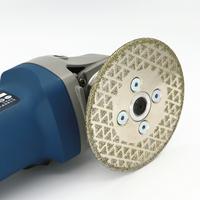
Laser welding uses a laser to fuse the segment to the steel core, producing a very strong bond between the two. That stronger joint matters most in dry cutting, where heat builds up and the segment-to-core attachment is under more stress. A laser welded blade is the type typically expected for dry cutting of hard materials, because it resists the heat and forces that would loosen a weaker joint. The diamond segment itself may still be hot pressed; laser welding describes how it is fixed to the core.
Vacuum brazed
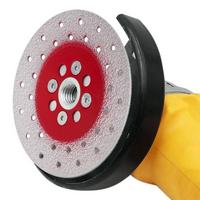
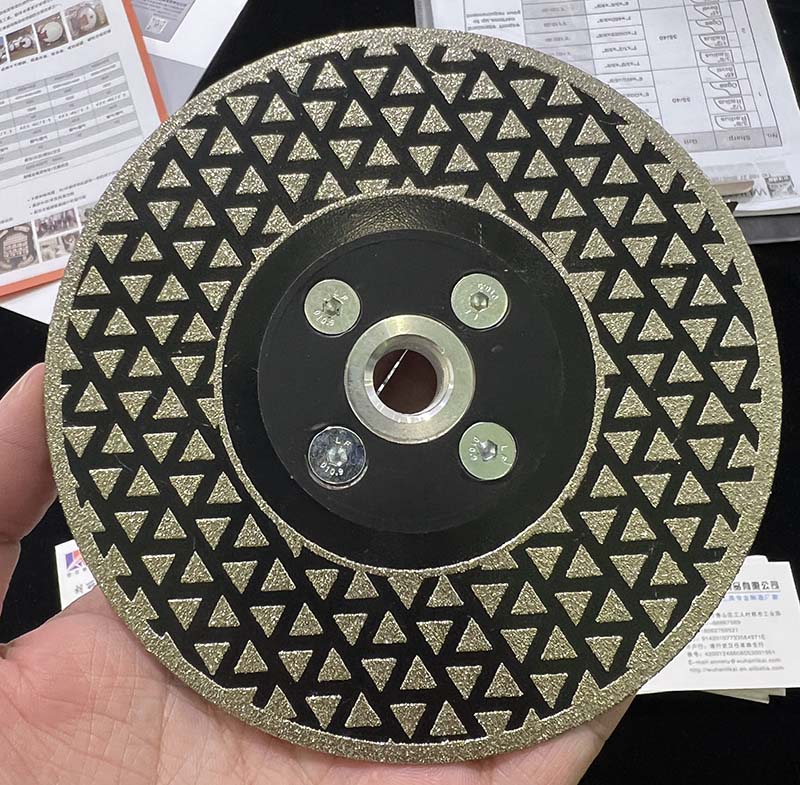
Vacuum brazing bonds a single layer of diamond directly onto a shaped steel body, usually in a vacuum furnace. The result is a tool that is sharp immediately and can be shaped to almost any profile, which makes it ideal for router bits, profile wheels, milling bits and thin-walled tools. Its limitation is life: because the diamond is a single layer, once it is worn the tool is finished. It cannot be dressed back the way a deep sintered matrix can. A vacuum brazed profile wheel shows how well the method suits shaped tools.
Comparing the three
- Hot pressed: diamond through a segment, versatile and cost-effective, strong in wet cutting.
- Laser welded: hot pressed segments fixed with a stronger joint, the standard for dry cutting of hard material.
- Vacuum brazed: single-layer diamond on a shaped body, sharp and profile-friendly, finite life.
For the bond that sits inside the segment regardless of method, see the bond matrix explained.
Which to use when
- Wet cutting with water available: hot pressed tooling is effective and economical.
- Dry cutting of hard material: laser welded, for the stronger joint.
- Profiling, milling and shaped tools: vacuum brazed, for the freedom of shape and sharpness.
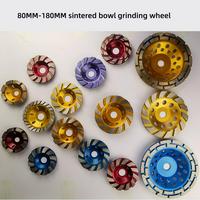
- Heavy grinding with long life wanted: sintered segments with a deep diamond layer.
What buyers should take from this
- Ask which manufacturing method a tool uses, not just 'good quality' - it tells you where the tool belongs.
- Match the method to wet or dry use; a hot pressed blade may not suit dry cutting of hard material.
- Check the joint quality, not only the segment, especially on dry-cutting tools.
- Accept that vacuum brazed tools have finite life - choose them for shape and sharpness, not longevity.
For how these choices appear on a product, see reading diamond blade labels.
Safety
Better manufacturing does not remove the need for safe use. Respect maximum RPM, keep guards fitted, wear eye and hearing protection plus a dust mask or respirator, inspect tools for damage before use and follow the manufacturer's instructions - especially where a tool's dry or wet rating is concerned. Never run a tool beyond the conditions its construction was designed for.
Manufacturing methods in short
- Hot pressed: versatile, wet-friendly, diamond through the segment.
- Laser welded: stronger joint, suited to dry cutting.
- Vacuum brazed: sharp, shaped, single-layer, finite life.
- Match the method to the use - browse the tool ranges for examples.