
 ES
Epoxy removal punishes the assumption that a floor coating behaves like the concrete under it. Concrete is brittle: diamond grinds it and it leaves as dust. Epoxy is a resin, and if the tool generates more heat than the machine can carry away, the coating softens, smears across the floor and re-deposits behind the segment. The result looks like a dull, gummy film rather than a stripped slab.
Everything about the setup follows from that difference.
Why epoxy behaves differently from concrete
Epoxy is softer than the substrate and far more sensitive to temperature. Two practical consequences follow. First, the tool needs to cut the coating rather than burnish it, which pushes you towards an aggressive, open segment and away from a fine, hard bond. Second, the machine has to keep the segment cutting instead of sitting in one place, because a stationary segment generates local heat fast.
That is also why a hard-bond tool designed for cured concrete is a poor choice here. It does not shed material quickly enough for a soft coating, so it loads up and starts polishing.
Block on a floor grinder, cup wheel on an angle grinder
Grinding blocks are designed to run on a floor grinder with multiple heads or a plate, where several blocks share the load and the machine's weight keeps them flat on the slab. That combination gives consistent contact across a wide area, which is what you want for stripping a floor.
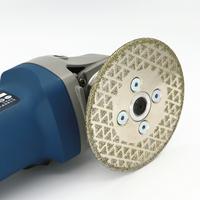
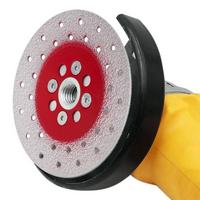
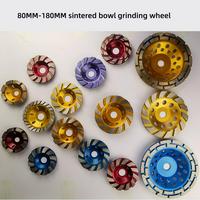
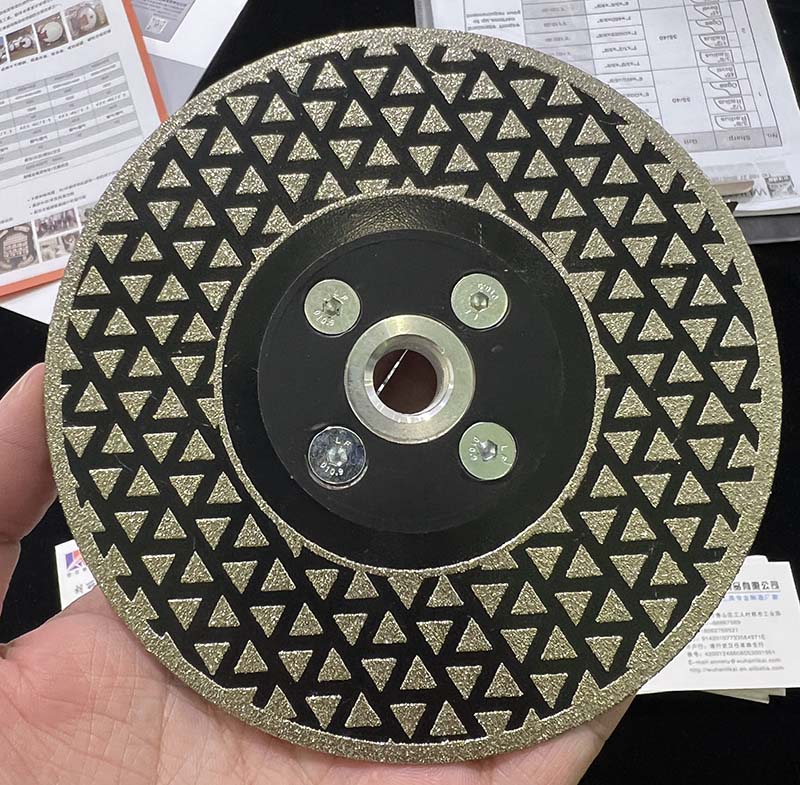
Cup wheels on an angle grinder suit edges, corners, door thresholds and small areas, where the floor grinder cannot reach. They remove material from a narrower band and are harder to keep flat, so they tend to leave a dished or ridged surface if used across a large open floor.
Where a single tool has to cover both, a wider cup wheel on a grinder can do the job with care, but expect a slower and less even result than a dedicated floor machine.
Segment style and bond
For coating removal, the tool needs to expose diamond quickly and clear the soft material away. Coarse, open segments with generous spacing do that. Fine segments and hard bonds do the opposite: they hold the diamond too long and pack the spaces between segments with softened epoxy, at which point the tool stops cutting and starts smearing.
Arrow and other aggressive segment shapes are common on coating removal work for this reason. If you are also planning to level or polish the concrete afterwards, that is a second, separate pass with a different tool — trying to strip and finish in one operation usually produces an uneven result at both ends.
Pass strategy matters more than machine power
Use several light passes in a cross-hatch rather than one heavy pass. Work in one direction across the floor, then turn 90 degrees and repeat. The second direction catches the ridges left by the first and gives a more even result.
Keep the machine moving. The most common cause of smear is a machine held in one spot while the operator waits for the coating to come up. On a large floor, plan the runs so you step across consistently and do not have to backtrack over sections that have already been stripped.
Between passes, check the surface with a scraper or a knife edge. If the epoxy is coming up as a gummy residue rather than a powder, the tool is generating too much heat: reduce the depth of cut, move faster, or change to a coarser segment.
Machine weight and downward force
Diamond grinding is designed to work with the weight of the machine, not with the operator leaning on it. Extra downward pressure on a soft coating mainly adds heat, which is precisely the thing that makes epoxy smear. Let the machine's mass do the work and control the machine, not the cut.
On a light single-head grinder, that may mean the cut simply has to be slower and shallower — which is still faster than clearing a smeared, gummy floor.
Before you start grinding
Note the coating thickness and how many layers are present, because a thick epoxy build-up may need several passes and a thinner coating over a weak screed is a different job entirely. Check for moisture in the slab and for a weak or friable surface layer under the coating; grinding a coating off a weak substrate can lift the substrate along with it.
Check the surface for anything that will damage the segments: embedded metal, hardened adhesive, or existing patches of different material. A quick scrape test in a corner tells you more about the coating than any assumption.
Dust, and why it is not optional to control
Grinding produces a mixed dust: cured epoxy particles and fine silica from the concrete. Both are worth taking seriously. Use a grinder with an effective vacuum and a suitable filter, keep the extraction working rather than blocked, and wear a respirator and eye protection. Do not dry-sweep the residue — that simply puts the dust back into the air.
Safety note: isolate the work area, wear eye protection, hearing protection and a suitable respirator, keep the dust extraction running, and use an RCD or GFCI protected supply. Follow the machine and abrasive manufacturer's instructions for the specific combination, and check local requirements for handling coating waste.
A working order
Confirm the coating and the substrate, then set up extraction. Take one light cross-hatch pass and check the result before committing to the whole floor. Adjust segment choice and depth of cut based on whether the coating is coming up as powder or as gum. Finish with a second direction pass, then decide whether the floor needs a separate levelling or polishing stage.
For the tooling side, the grinding disc and tools category covers blocks, cup wheels and segments. On coating removal specifically, a diamond floor grinding block for epoxy floors is the direct match, with a concrete floor grinding disc for levelling afterwards and a 100mm cup wheel for edges and small areas.
Two related guides are worth reading before a large job: dust control when grinding concrete, and the broader overview of concrete floor preparation tools for what comes after the coating is off.
If a coating is proving stubborn or smearing despite a change of segment, send the coating type and thickness, the machine, and the area involved, and the tooling and pass strategy can be reviewed against it.