
 ES
A 20 mm glass tessera behaves nothing like a 600 mm porcelain slab. There is no mass to damp vibration, no spare material to absorb an edge break, and very little surface area to clamp. Most breakage happens before the blade has done any real cutting.
Support and holding
The piece needs continuous support right up to the cut line, plus a way to hold it without crushing it. A flat sacrificial backing board, a fine non-slip mat, and a light clamp or a hand-held push block usually work better than a conventional vice. Mesh-mounted mosaic sheets should be cut as a sheet where possible, with the mesh side supported and the cut line kept away from the sheet edge.
Avoid cutting a single loose tessera freehand. If a one-off piece must be cut, bed it into a temporary mounting medium so that the blade never has to hold the piece against the wheel.
Blade and machine
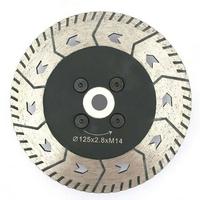
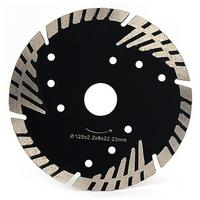
A thin continuous-rim diamond blade removes the least material and delivers the fewest impacts per unit length. Segmented blades strike the glass edge in pulses, and each pulse is a chance to start a crack. A wet tile saw with a steady water feed and a sliding table gives far better control than a handheld grinder on these formats.
Spindle speed should be matched to the blade marking rather than set as high as the tool will go. The rpm matching guide covers the relationship between diameter, spindle speed, and rim speed. For brittle materials more generally, the narrow sliver and mosaic strip guide describes the same support logic at a larger scale.
Feed and water
- Start with the blade at speed and introduce the work slowly; do not push the piece into a stationary blade.
- Feed in one direction. Reversing out of a partial cut often chips the exit edge.
- Keep water on both faces. Glass is sensitive to thermal shock as well as mechanical shock.
- Stop before the last millimetre and break the final web by hand if the piece is very small.
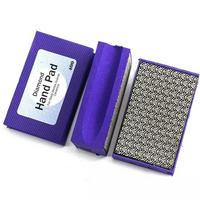
- Dress the edge lightly with a hand pad if the arris will be visible or handled.
Drying and handling after cutting
Glass mosaic holds water at the cut edge and in the mesh backing. Let pieces drain on a clean, flat rack before they are fixed, and keep the cut faces from rubbing against each other during transport.
If a batch has to be cut in one session, plan the order so the smallest pieces are done first while the blade is still cool and the operator is fresh. Small formats are unforgiving of a tired hand, and the last few pieces of a long run are where most breakage happens.
Tooling and safety
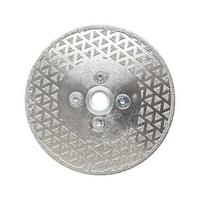
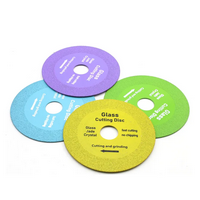
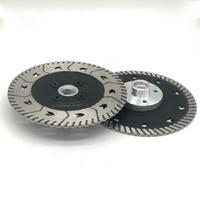
Browse the tile tools category for thin-rim blades. A thin glass and ceramic cutting disc is built for brittle, small-format work, while a tile-specific cutting blade suits larger ceramic pieces where a slightly wider kerf is acceptable.
Wear eye protection and a face shield where fragments are possible, keep the guard fitted, and use an RCD-protected supply for wet cutting. Confirm the blade's rated rpm, isolate the tool before changing a blade, and never hold a loose piece by hand near the wheel.