ES
Glass reinforced plastic cuts easily in one sense and destroys tooling in another. The polymer matrix is soft, but the glass fibres are hard and abrasive. A blade that sails through the first metre can be noticeably duller by the end of a long run, and the visible edge often shows a fuzzy, separated laminate rather than a clean line.
Two competing problems
Abrasive wear comes from the glass. It attacks the bond and the steel core, and it does so without producing the coarse chips that would help clear the kerf. Heat comes from the polymer, which softens, smears, and re-deposits on the segment. Together they load the blade and push the operator toward more feed pressure at exactly the wrong moment.
Delamination is the third problem. Layers separate ahead of the blade when the panel is unsupported, when the tool exits into free space, or when a coarse segment hammers the laminate instead of shearing it. The carbon fibre composite cutting guide covers a different fibre system with the same separation risk.
Setup that works
- Support both faces. Clamp the panel between sacrificial boards with the cut line close to the support.
- Fine, thin rim. A narrow continuous or fine turbo edge shears fibres instead of plucking them.
- Sharp tooling dedicated to the job. A blade worn on GRP will tear the next panel rather than cut it.
- Controlled speed and feed. Keep spindle speed within the blade marking and let the tool maintain it.
- Plan the exit. A backing strip prevents the last few millimetres from blowing out.
The fibre cement cutting guide is a useful comparison: both materials are abrasive and dusty, but cement board is brittle where GRP is fibrous and flexible.
Dust and skin protection
Cutting GRP releases fine glass particles and resin dust that irritate skin and airways. Use local extraction with a suitable filter, wear a respirator rated for the exposure, and cover exposed skin. Clean with a vacuum, not compressed air, and keep the cutting area separate from finishing work.
Planning the cut order
Where a panel has a finished face, orient the cut so the blade exits into the backing board rather than into the visible laminate. On a saw table that means loading the panel face-up; on a handheld tool it may mean cutting from the reverse side after marking through.
Mark with a fine pencil line and a strip of low-tack tape rather than a scribed line, which can start a split along the fibres. Cut the least visible edge first as a test of blade condition and support before committing to the finished edge.
Choosing tooling and working safely
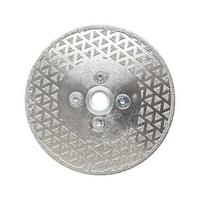
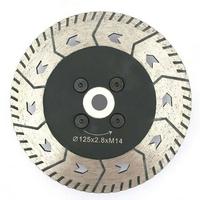
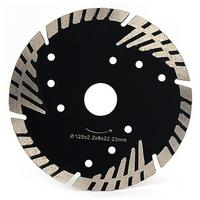
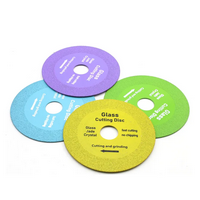
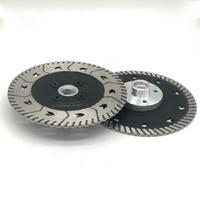
Browse the cutting disc category for thin-rim blades. A thin glass and ceramic cutting disc suits fine laminate work, while a sintered turbo blade has the open segment geometry that helps when heat and loading build on thicker panels.
Clamp the panel, keep the guard fitted, and wear eye protection, gloves, hearing protection, and a respirator rated for the exposure. Confirm the blade's rated rpm before starting and isolate the tool before changing a disc.