ES
A 200 mm opening with a rig rated for 100 mm is a common site problem. The answer is usually a series of overlapping holes rather than a bigger machine, and the quality of the result depends almost entirely on how the holes are spaced and sequenced.
Why a small rig cannot just run a big bit
Torque and rigidity are the limits. A large bit needs more torque to turn and a stiffer mast to keep it from walking. Put a 200 mm bit on a light rig and the motor stalls, the stand flexes, or the bit binds — and a binding bit on a light stand can rotate the whole assembly.
Stitch drilling sidesteps the torque problem by keeping the bit diameter within the rig's capability.
Layout and overlap
Mark the opening outline, then lay out hole centres along the perimeter. Overlap each hole with the next by roughly a quarter to a third of the diameter. Less overlap leaves webs of material between holes that are difficult to break out; more overlap wastes time and increases the chance of the bit wandering into the previous hole.
Keep the holes inside the line, not on it. The finished edge is then trimmed with a grinding cup or a saw, which gives a cleaner result than trying to break out on the marked line.
Sequence
Drill alternate holes first, then fill in between them. This gives each bit a solid area to start in and reduces the tendency to wander when the bit breaks into an existing hole.
On a vertical wall, work from the top down so the slurry drains away from the cut. On a floor, work from one side across to avoid trapping water in a pocket.
Breaking out the centre
Once the perimeter is drilled, the centre is a loose plug held by the webs between holes. Break it out with a chisel or a pry bar, working from the centre outward. On a reinforced section, stop and check with the engineer before removing anything — stitch drilling around rebar leaves a plug that is still tied to the structure.
Finishing the opening
The stitched edge is scalloped. True it up with a grinding cup on an angle grinder, or with a saw if the opening has straight sides. For a pipe penetration or a duct opening that will be covered by a sleeve or a trim ring, a scalloped edge may be acceptable; for an exposed opening, it will not.
Where stitch drilling is the wrong answer
- Structural openings. A large opening in a load-bearing element needs an engineer's design, not a layout decided on site.
- Post-tensioned slabs. The risk of cutting a tendon is too high for a stitch pattern drilled without a scan.
- Openings that must be circular and precise. A stitched circle is never truly round. Use the correct rig.
- Deep sections. Overlapping deep holes multiplies the binding risk.
Tooling
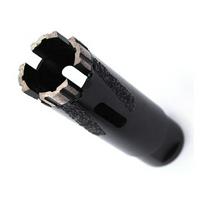
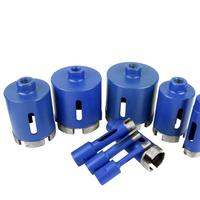
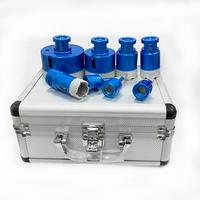
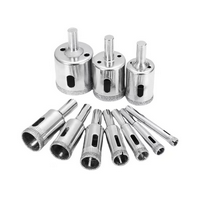
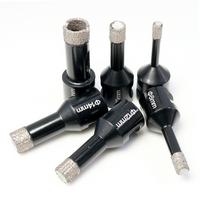
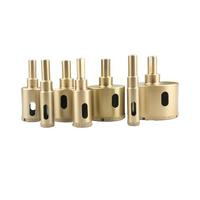
Start from the diamond drill bit category. A range of vacuum brazed core bit diameters lets you keep each hole within the rig's capacity, and a tile and concrete core bit covers the finish work around the opening.
Two related reads: turbo segment core bits, and drilling speed and pressure.
Safety
Stitch drilling produces more dust, more slurry, and more opportunities for the bit to bind as it breaks into an adjacent hole. Keep the rig anchored, reduce feed when a bit is about to break through, and wear eye protection, hearing protection, and a respirator. Never stand in line with a rotating assembly that might kick.
If you are planning a large opening and want to confirm whether stitch drilling suits the section, send the dimensions, thickness, and reinforcement details and we will advise.