ES
Hole saws and core bits both cut round holes in hard material. The resemblance ends there. Choosing the wrong one wastes a hole, a bit, or a panel, and the difference is easier to see once you look at wall thickness and how the tool clears debris.
What a diamond hole saw is for
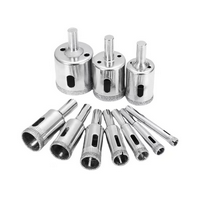
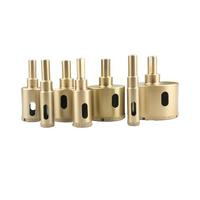
A diamond hole saw is a thin-walled barrel with diamond abrasive on the rim, usually run on an M14 grinder or a drill. The thin wall means it removes little material, cuts fast in tile and porcelain, and produces a clean edge.
Its limitation is depth. The barrel has a fixed height, so the maximum depth is the barrel length minus the arbor. That makes it a through-hole tool for tile, slab, and thin stone rather than a coring tool for thick concrete.
What a core bit is for
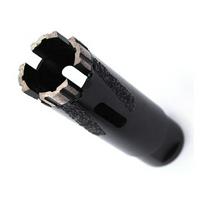
A core bit has a thicker wall and a deeper barrel, with segments brazed or sintered onto the rim. It is built to cut deep holes in concrete, masonry, and stone, and it is usually run on a stand with water feed.
The thicker wall removes more material and needs more torque, which is why core bits are paired with rigs rather than hand drills for anything above a modest diameter.
Choosing by job
- Through-tile penetration for a pipe or fitting: hole saw. Thin wall, clean edge, fast.
- Anchor or dowel hole in concrete: core bit, or a carbide bit for small diameters.
- Deep hole through a wall: core bit with a stand and water.
- Large opening in tile: hole saw for the perimeter, then a grinding cup or saw to finish.
- Hole through tile into concrete behind it: hole saw through the tile, then a core bit for the concrete. Two tools, one hole.
Where each one fails
A hole saw used past its depth binds in the hole and burns the rim. The barrel fills with core material and there is nowhere for the debris to go.
A core bit used on a hand drill at a large diameter is a kickback waiting to happen. The bit grabs, the drill twists, and the operator's wrist absorbs the torque.
Debris clearance
Hole saws clear debris through the flutes or slots in the barrel wall. Core bits clear through water flow around the barrel. Both depend on the operator not packing the cut — a hole saw with a full barrel and a core bit with a packed annulus fail in the same way.
Edge quality
Hole saws generally leave a cleaner entry on tile because the thin rim concentrates pressure. Core bits leave a slightly rougher edge but can be dressed with a grinding cup. On a visible surface, the hole saw is usually the better finish tool; on a structural hole that will be filled, edge quality matters less.
Tooling
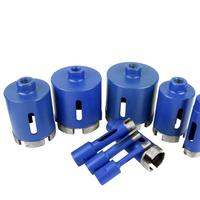
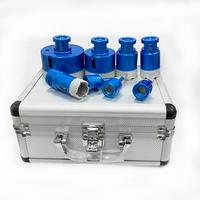
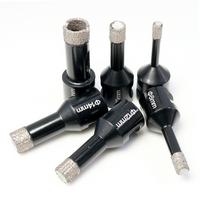
Start from the diamond drill bit category. An M14 hole saw kit covers tile and stone work, and a core bit for tile and concrete handles the deeper penetration.
Two related reads: what to look for in an M14 hole saw kit, and choosing drill bit sizes.
Safety
Both tools can bind and kick. Use a stand for core bits above small diameters, keep the guard in place, and wear eye protection, hearing protection, and gloves. Water-fed tools need RCD protection. Support the workpiece so it cannot move when the bit breaks through.
If you are unsure which tool suits a specific hole, send the material, diameter, and depth and we will confirm.