
 ES
The wattage printed on an angle grinder tells you how much electrical power the motor can take, not how well it will hold a blade in a cut. That distinction only becomes obvious on site, when a 125 mm blade starts to slow in dense concrete and the operator pushes harder to compensate.
What the rating actually describes
Input wattage is the power drawn from the supply. Output power at the spindle is lower once copper losses, gear friction, and electronic controls take their share. Two machines with the same input figure can behave differently under load because their gearing and motor curves differ.
More useful than the headline number is how the machine behaves as resistance rises. A grinder with good torque reserve keeps spindle speed close to its rated value as the blade bites. A marginal machine drops speed quickly, and the diamond segments then rub instead of cutting. Rubbing generates heat, glazes the bond, and shortens the working life of the segment.
Why diameter changes the calculation
Blade diameter does two things at once. It increases the length of the arc in contact with the material, and it increases the leverage that the work can apply back to the spindle. A 230 mm blade asks far more of a motor than a 115 mm blade in the same material, even when both are rated for the same spindle speed.
This is why the same grinder can feel effortless with a thin tile disc and laboured with a segmented concrete blade. The disc removes a narrow kerf; the concrete blade removes a wide one across a longer contact arc.
A sensible starting point is to pick the blade for the depth of cut required, then check that the machine is built for that diameter. Fitting a large blade to a small grinder with an adapter is a mechanical possibility and usually a poor decision: the guard no longer covers the exposed edge, the flange clamping area shrinks relative to the load, and the motor runs near its limit for the whole shift.
Spindle speed and peripheral speed
Rated rpm is a property of the tool; the speed at which the diamond grit meets the work is a property of rpm and diameter together. Fitting a larger blade to the same spindle raises the rim speed. Check the blade marking for its maximum operating speed and keep the tool's rated rpm within it. Our note on matching rpm ratings across blades, cup wheels, and core bits covers the arithmetic in more detail.
Other things that matter as much as watts
- Soft start and restart protection. These reduce the snatch at switch-on and stop the tool restarting unexpectedly after a power interruption.
- Electronic speed control. Holding speed under load matters more for cutting consistency than a higher no-load figure.
- Gear head and bearing size. Sustained side loading on a small gear head produces heat and play, which shows up later as blade wobble.
- Mass and balance. A heavy grinder reduces the pressure the operator needs to apply, but becomes tiring on vertical and overhead work.
- Duty cycle. Continuous cutting in cured concrete is harder on a motor than intermittent tile trimming.
Reading the signs during a cut
A healthy setup sounds steady. A falling note, a burning smell, discolouration near the segments, or a blade that needs constant forward pressure all point to a mismatch between tool, blade, and material. Pushing harder rarely fixes it; the usual fix is a blade with a bond better suited to the aggregate, or a shallower pass.
If the machine slows sharply as soon as the blade enters the cut, stop and check the obvious things first: a worn carbon brush, a loose flange, a dull blade that has glazed over, and an extension lead that is too long or too light for the current draw.
Choosing the blade and working safely
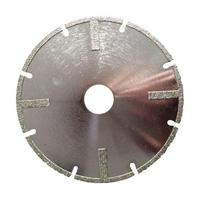
Start from the diamond saw blade category and filter by diameter and material. For mixed concrete and masonry work a 125 mm general-purpose blade suits a mid-size grinder, while a tile-specific cutting blade removes far less material and lets a smaller tool stay in its comfort zone. The angle grinder safety checklist is worth revisiting whenever the blade diameter changes.
Keep the guard fitted and adjusted, wear eye protection and hearing protection, and isolate the tool before changing a blade. Confirm that the rated rpm on the blade meets or exceeds the tool rating, and that the flange and arbor are clean before tightening.