ES
A new operator is usually trained by being handed a saw and told to watch someone. That transfers habits rather than knowledge, and the habits transferred are whatever the person being watched happens to do.
A structured first week is not a formal qualification. It is a sequence that puts the dangerous knowledge first and the productive knowledge second, so that the operator understands the risk before they are asked to manage it.
Day one: the machine and the hazards
The first day is not about cutting. It is about the machine, the guards, the controls, and what happens when something goes wrong.
- Identify the guard, the water controls, the emergency stop, and the isolation point.
- Explain what the blade does at speed, and why a blade failure is different from a tool failure.
- Show the PPE requirement and explain why each item is there, not just that it is required.
- Demonstrate a blade change, then have the trainee do it under supervision.
Blade changing is the first practical skill because it is where the most common errors occur: a cross-threaded nut, a missing reducing ring, a blade fitted the wrong way round. An operator who can change a blade correctly has understood the machine.
Day two: observation with a purpose
Watching is only training if the observer knows what to look for. Give the trainee a specific list: the water reaching the blade, the sound of a cut that is going well, the feed rate on a straight cut, the way the operator's body is positioned relative to the blade.
Ask for observations at the end of each cut. A trainee who can describe what a good cut sounds like is already partway to producing one.
Day three and four: supervised cutting on scrap
Start on scrap, not on customer material. Scrap allows mistakes to be discussed rather than hidden, and it allows the trainer to watch the technique rather than the clock.
Introduce one variable at a time: a straight cut first, then depth control, then a change of material, then a curve or a confined position. Adding variables faster than the trainee can absorb them produces a person who can do everything badly.
Correct the body position early. Standing to one side of the blade, with both feet planted and the feed coming from the hips, is a habit that is hard to change later and easy to establish now.
Day five: the checks an operator owns
By the end of the first week, the operator should own the pre-use checks rather than being checked. That means the daily routine: blade condition, flange seating, water flow, guard security, and a test cut.
A trainee who can carry out these checks and explain why each one matters is ready to cut under supervision on real material. One who can only recite the list is not.
What to teach about the blade
Operators do not need to know the metallurgy, but they do need to know what the blade is telling them. A blade that is glazing sounds different, cuts slower, and shows a shiny segment. A blade that is worn out shows a reduced segment height and an increased current draw.
The relationship between peripheral speed and blade diameter is the one piece of arithmetic worth teaching, because it explains why a large blade on a small machine is a bad idea. It is set out in blade peripheral speed, and a trainee who understands it will not fit the wrong blade.
Common habits to correct early
- Leaning over the blade to watch the line, which puts the face in the failure path.
- Pushing harder when the cut slows, which glazes the blade and loads the machine.
- Removing the guard for a "quick" cut, which is how most serious injuries happen.
- Reaching past a running blade to clear chips.
- Cutting dry because the water is inconvenient.
Each of these is easier to prevent in week one than to correct in year three.
Recording competence
Keep a simple record: the date, the machine, the operation, and the trainer's signature. The record is useful for the operator, for insurance, and for demonstrating that training happened. The next stage, a formal sign-off, is covered in core drill stand setup for drilling and can be adapted for sawing.
Tooling notes
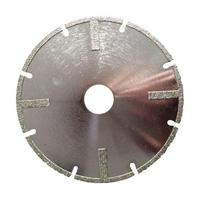
Training is easier on a blade that behaves predictably. A 125 mm diamond blade for granite, marble and concrete is a good teaching blade because it gives clear feedback and tolerates small technique errors. A sintered turbo blade for porcelain and marble is the next step, since tile work punishes poor technique with visible chipping. The diamond saw blade category lists the range.
The general safety baseline is in angle grinder safety checklist, which is worth covering in the first session rather than the last.
Safety
No trainee cuts unsupervised, and no trainee cuts without PPE. Confirm the blade's rpm rating against the machine before every session, keep the guard fitted, and ensure water or extraction is working before the first cut. Stop the session if the trainee is tired or rushed; most training injuries happen in the last ten minutes of a long day.