
 ES
Wobble is easy to feel and surprisingly hard to locate. The blade is the part you can see moving, so it gets blamed first, but most runout comes from the parts holding it or from the machine behind them. Replacing a sound blade wastes money and leaves the vibration in place.
Isolate the assembly before the machine
With the tool unplugged or the battery removed, clean the arbor, both flanges, and both faces of the blade centre. A few grains of concrete or a small burr on the clamping face will tilt the whole disc. Check that the bore sits on the spindle without play and that the flange diameter matches the blade specification. The thread and arbor compatibility guide covers the cases where a threaded hub is involved rather than a plain bore.
Spin the blade slowly by hand and sight the rim against a fixed reference such as the guard edge. A small, steady sideways movement at the rim may be within the blade's own tolerance. A movement that repeats at the same point in each revolution points to a bent blade or an off-centre seating; a general shimmy points to looseness.
Work through the likely causes
- Dirty or damaged flanges. The most common cause and the easiest to fix. Worn flanges no longer clamp flat and should be replaced as a pair.
- Reducing rings and adapters. A ring that stands proud of the blade face means the nut clamps on the ring, not the blade. Stacked rings multiply alignment error.
- Spindle bearing play. Grip the spindle and try to move it side to side. Any perceptible movement will be amplified at the rim under load.
- Blade condition. A dished or heat-damaged core stays out of plane even when mounted correctly.
- Speed. Running a large blade above its intended rpm can set up a resonance that looks exactly like mechanical runout.
Separating blade from machine
Swap the suspect blade onto a different tool and fit a known-good blade onto the original tool. If the wobble follows the blade, the blade is at fault. If it stays with the machine, look at the spindle and bearings. This two-minute test is more reliable than inspecting either part on its own, and it avoids ordering a replacement spindle for a problem caused by a dirty flange.
Why it matters beyond a rough cut
Runout widens the kerf, loads one side of every segment, and puts a repeating bending load into the steel core. Over time that produces fatigue cracks near the centre and uneven segment wear around the circumference. It also increases vibration at the handle, which is an exposure issue on a full shift rather than just a finish issue. The rpm matching guide explains the speed side of the same symptom.
Tooling and safe practice
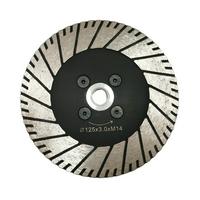
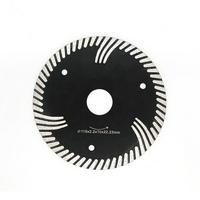
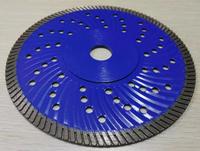
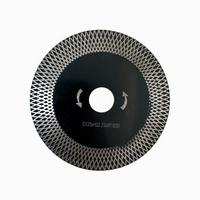
Browse the diamond saw blade category for blade and flange specifications. A segmented 125 mm blade and a double-sided cutting and grinding disc have different mounting arrangements, and each should be seated to its own flange requirement.
Isolate the tool before inspecting or changing a blade, keep the guard fitted, and wear eye protection and hearing protection. Confirm the blade's maximum rated rpm against the tool, and never run a blade that is visibly bent or cracked in the core.