
 ES
Coastal and marine concrete is the same material as inland concrete in the same way that a sea wall is the same as a retaining wall. Chemically and practically, it is not. Chlorides penetrate the concrete, the reinforcement corrodes from the inside, and the material you are cutting is often weaker than the drawings suggest and harder than the blade expects.
Add tide windows, salt spray, and restricted access, and the job becomes a planning exercise with a cutting task inside it.
What salt does to the concrete and the tool
Chloride ingress causes reinforcement to corrode and expand, which cracks the concrete from within. The result is a structure that looks sound and is locally delaminated. A blade that hits a corroded bar can grab, and a blade that hits a void can drop suddenly.
The practical consequence is that the cut has to be inspected as it progresses. A cut that suddenly changes sound or resistance is telling you that the material has changed, and the response is to slow down rather than push through.
Salt also attacks the machine. A saw that runs on a marine site will corrode at every bare steel surface, and a rig that is left wet will seize. Wash down at the end of every shift, grease the exposed threads, and accept that marine work consumes equipment faster than inland work.
Tide and water level planning
On a tidal structure, the working window is set by the water. That may mean cutting from a platform at low tide, or cutting above the waterline with the lower part of the cut completed on a different tide. Plan the cut sequence so that the part below the waterline is done first, while it is accessible, rather than last.
Wave action matters as much as tide. A calm forecast is part of the method statement, and a cut that is half finished when the weather turns is a cut that may have to be abandoned and restarted.
Where the work is below the waterline entirely, that is a diving or a cofferdam operation with its own procedures, and the tooling has to be suited to wet operation.
Wet cutting in a wet environment
The irony of marine work is that water is everywhere except where it is needed. Wet cutting still requires a controlled supply at the blade, not a splash from the sea. Salt water is a poor coolant for a diamond blade because the salt crystallises in the water passages and the swarf is more abrasive.
Use fresh water where possible, and flush the machine and the blade afterwards. A blade that is left with salt water in the kerf will show corrosion at the segment joints, and a corroded core is a weakened core.
Where fresh water is not available, accept a shorter blade life and inspect more often. The economics change; the method does not.
Reinforcement and corrosion
Corroded reinforcement has lost steel section, but the rust occupies several times the volume of the metal it replaced, which is what splits the surrounding concrete. A blade passing through it may meet a thinner bar, a void, and a lump of loose material in the same cut. Consistent feed and a blade that is not too hard is the practical response, and the relationship between bond hardness and this kind of mixed material is described in diamond tool bond matrix.
Where the reinforcement is severely corroded, the structural engineer's assessment comes before the cut. A cut that removes a load path in a corroded structure is a different risk from the same cut in a sound one.
Cold, heat, and the blade
Coastal work often happens in cold, wet conditions, and cold concrete behaves differently. A blade that is suited to warm, dry concrete may glaze in cold, damp material, and the cut slows without an obvious cause. The effect is described in cold weather concrete cutting.
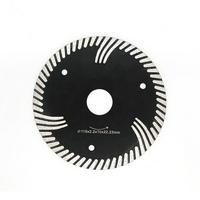
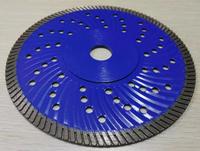
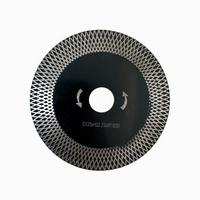
Blade choice for marine work tends towards a softer bond that keeps cutting in damp, variable material, with a segment depth that allows for the reinforcement. A 125 mm diamond blade for granite, marble and concrete is the baseline for general concrete, and a sintered turbo blade is useful where a cleaner edge is needed on a visible face. The diamond saw blade category covers the range.
Surface condition and finishes
Marine concrete often shows efflorescence, salt bloom, and biological growth. Cutting through a contaminated surface spreads contamination onto the fresh cut, and the repair has to address both. The diagnosis of white bloom is covered in efflorescence and white bloom on ground concrete surfaces.
Where a cut face will remain exposed, the repair material has to be suited to a chloride environment, and the reinforcement cover has to be restored. A cut that leaves a bar at the surface will corrode first and spall later.
Safety
Marine sites bring drowning risk, slips, and weather. Wear a buoyancy aid where there is a risk of falling into water, use a harness on unprotected edges, and never work alone on a tidal structure. Wear eye and hearing protection, use residual current protection for all electrical tools, and wash down equipment and exposed skin at the end of the shift.