
 ES
A precast plant is a factory, and factory work is judged on repeatability. Cutting one panel accurately is a skill. Cutting the same panel two hundred times within tolerance is a process, and the process is what the plant is buying.
The material adds its own complication: much of the cutting happens on concrete that is young, and young concrete behaves differently from the cured material that most guidance describes.
Repeatability before speed
The first requirement is a fixture, not a faster blade. A jig that positions the element against a fixed stop, with the saw on a fixed line, removes the operator from the tolerance equation. Once the fixture is right, the blade only has to be consistent.
Set the fixture from a reference on the element that is itself reliable. On a precast panel, that is usually the mould face or a cast-in datum, not the rough edge. Reference from the wrong feature and every piece inherits the same error, which is worse than random error because it is invisible until assembly.
Check the first piece, then the tenth, then the hundredth. A fixture that drifts will show a trend, and a trend caught at piece ten is cheap.
Cutting young concrete
Precast elements are often cut or cored within days of casting, which means the concrete has not reached full strength and is more abrasive than mature concrete. A blade that works well on a cured slab can wear quickly on green concrete, because the cement matrix is softer and the aggregate is not yet fully bonded.
The window for cutting is a trade-off. Cut too early and the edges ravel and the aggregate pulls out. Cut too late and the concrete is hard and the blade wears. The optimum is usually a few days after casting, and the plant's own testing should set it.
Green concrete also releases moisture as it is cut, which changes the slurry and the cooling. The behaviour is described in cutting green concrete, and the practical adjustment is more water and a slower feed.
Coring in precast
Holes in precast elements are usually for services, lifting inserts, or connections. Each has a tolerance, and each has a risk of hitting reinforcement or a void.
- Service penetrations. Position tolerance is usually generous, but the hole has to be clear of reinforcement and of the element's prestressing strands.
- Lifting inserts. Position is critical and set by the lifting design. A misplaced insert is a handling hazard, not a cosmetic issue.
- Connection holes. These align with another element, so the tolerance is cumulative across two pieces and has to be tight.
In prestressed elements, cutting a strand is a serious event. Establish the strand positions from the shop drawings and confirm with a cover meter before drilling. Where a hole has to pass close to a strand, the engineer's approval comes before the drill.
Finishing the cut face
A precast element usually has a specified face finish, and a cut face is often left exposed. That means the cut has to be clean enough to be seen, or it has to be finished afterwards.
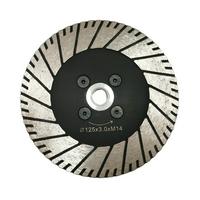
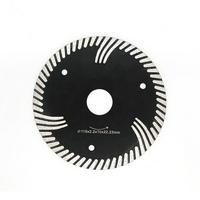
A blade with a fine bond and a narrow kerf gives a cleaner face than an aggressive one, at the cost of speed. On a production run, the balance is set by how much finishing the plant is prepared to do.
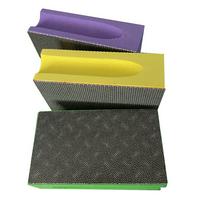
Where the face has to be ground, a cup wheel brings it flat quickly, and the surface can then be finished to match the mould face. The 100 mm diamond cup wheel for granite and cured concrete is the usual tool once the element has gained strength; on young concrete a wheel specified for cured, dense material loads quickly and can pull aggregate, so grinding is usually scheduled after the curing window or done with a coarser wheel suited to abrasive green concrete. The sheen or texture standard is set by the project rather than by the tool.
Water, slurry, and the plant environment
A precast plant recycles water, and slurry in the recycling system is a problem. Cutting stations should have their own settlement, and the clarified water should return to the process rather than to a drain.
Dust is the other environmental issue, especially where dry cutting is used for small adjustments. The control logic is the same as on site, covered in dust extractor sizing, but in a fixed plant it is worth investing in a proper capture hood rather than a portable extractor.
Tooling notes
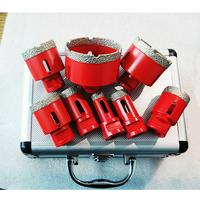
For coring, a 5 mm to 150 mm vacuum brazed core bit range covers the common service and connection diameters, and a diamond core drill bit set covers the small holes. For high-strength and thin-section elements, the behaviour of the material is closer to what is described in cutting ultra-high performance concrete.
The diamond drill bit category lists the sizes and shank types, and a spare bit for each common diameter is worth keeping; a plant that stops for a worn bit loses more than the bit costs.
Safety
Precast elements are heavy and can move unexpectedly when cut, particularly if they are not fully supported. Support both sides of a cut before the blade reaches the end, and never stand in the path of a falling section. Wear eye and hearing protection, keep guards fitted, and check the blade's rpm rating. Use residual current protection for wet tools, and isolate before changing a blade or a bit.