ES
Most sourcing decisions are made on three data points: price, lead time, and how the last order went. That is enough to compare two quotes for the same part. It is not enough to compare two suppliers, because the things that decide whether an order succeeds are rarely on the quotation.
A scorecard fixes that by forcing the same questions to be asked of every candidate, in the same order, with a weight attached to each answer.
Choosing the criteria
Six criteria cover most of the risk in diamond tool sourcing. Each should be scored on evidence, not on impression.
- Specification control. Can the supplier state the segment composition, bond, core steel, and dimensional tolerance in writing, and repeat it on the next order?
- Consistency. Do successive batches measure the same? This is the criterion that separates a competent supplier from a lucky one.
- Documentation. Marking, packaging, and paperwork that matches the shipment. The detail is covered in EN 13236 and oSa markings.
- Responsiveness. How quickly and how completely questions are answered before the order, which predicts behaviour after it.
- Commercial terms. Price is part of this, alongside lead time, payment terms, and how changes are handled.
- Audit and traceability. Whether the supplier can show where the material came from and how the batch was controlled. The checklist for this is in factory audit for diamond tool suppliers.
Six is a manageable number. A scorecard with twenty criteria gets filled in once and never used again.
Weighting
Weights turn a list into a decision. They depend on what the buyer is doing.
- Private label and brand-building. Weight consistency and specification control highest; a batch that varies damages the brand more than a higher price does.
- Distribution and stock. Weight lead time and commercial terms; a distributor's problem is availability, not segment metallurgy.
- Project supply. Weight documentation and traceability; the paperwork is what the client's inspector will ask for.
Set the weights before scoring any supplier, or the weights will drift towards whichever supplier is already preferred.
Scoring on evidence
Each criterion needs an evidence rule. For consistency, the evidence is three batches measured on the same gauge, not a statement that the factory is consistent. For documentation, it is a sample shipment's paperwork, not a template.
The most useful evidence is a trial order. A trial tests the whole chain: quotation, confirmation, production, packing, shipping, and the arrival condition. The design of a trial is a separate exercise, covered in sample evaluation protocol.
Score the trial, not the meeting. A supplier that performs on a small order is a reasonable bet for a larger one; a supplier that performs in a presentation is a presentation.
Reading the scores
A scorecard is most useful when it disagrees with the instinct. A supplier that scores well on price and poorly on consistency is a supplier that will generate claims, and the arithmetic of a claim usually exceeds the price advantage.
Look at the spread as well as the total. A supplier that scores 3 out of 5 on everything is more predictable than one that scores 5 on four criteria and 1 on two. Predictability is what a supply chain needs.
Re-score annually, and re-score after any quality event. A scorecard that is filled in once is a record of a past decision, not a tool.
What to put in the contract
The scorecard informs the specification. Anything scored as important should appear in the purchase order as a requirement: tolerance, marking, packing, and the acceptance criteria for a batch.
Where consistency is the top criterion, specify a measurement method and a sampling plan. Where documentation is the top criterion, specify the documents by name. A requirement that cannot be measured cannot be enforced.
Using the tools you buy
The evaluation does not end at the loading dock. A blade that scores well on paper but glazes in the application has failed, and the failure has to feed back into the score. The symptom set that indicates a bonding or specification problem rather than an operator problem is described in diamond tool troubleshooting.
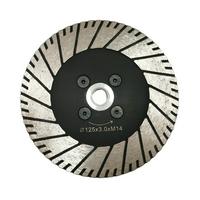
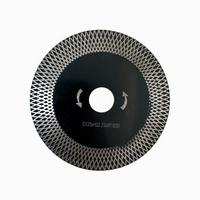
For the product side, a 125 mm diamond blade for granite, marble and concrete is a useful reference item because it is used across many applications and its behaviour is easy to compare between batches. A sintered turbo blade for porcelain and marble makes a good second reference, since tile work exposes edge quality differences quickly. The diamond saw blade category gives the range to specify against.
Safety
Sourcing decisions have safety consequences. A blade whose marked maximum speed does not match the machine, or whose core steel is under-specified, is a hazard. Confirm the rpm marking and the dimensional tolerance before accepting a batch, wear eye protection when inspecting blades, and reject any blade with a distorted core or a damaged bore.