ES
A diamond tool order placed today and delivered in four months carries two exposures that the unit price does not show: the exchange rate and the cost of the inputs. Both can move enough to turn a margin into a loss, and both are usually left out of the contract because the negotiation is about the unit price.
A price adjustment clause is the standard way to handle this. Written badly, it becomes a source of disputes; written well, it is a formula that nobody argues about.
Why fixed prices fail on long orders
A supplier quoting a fixed price for a long delivery is pricing the risk into the quote. That is not necessarily bad for the buyer, but it is invisible: the buyer cannot tell whether the price reflects a competitive offer or a large risk premium.
Where the buyer insists on a fixed price and the supplier accepts, the risk appears later in a different form: a request to substitute a material, a delay, or a quality reduction that is hard to detect. The price did not change; the product did.
An adjustment clause is therefore not a concession to the supplier. It is a way to keep the specification stable.
The currency question
Three approaches are common.
- Price in the supplier's currency. The buyer carries the exchange risk. Simple to administer, and the exposure can be hedged if the order is large enough.
- Price in the buyer's currency. The supplier carries the risk and prices it in. The buyer gets certainty and pays for it.
- Price in one currency with a reference rate band. The price holds within a band, and adjusts outside it. This is the most common compromise.
Whichever is chosen, name the source of the rate. A clause that refers to "the prevailing exchange rate" is not a clause; it is an invitation to argue. Specify the source, the publication time, and the date on which the rate is taken.
Adjusting for input costs
Diamond tools are sensitive to steel, diamond grit, and energy. A raw material adjustment clause links the price to a published index or to a documented cost, with a threshold below which no adjustment is made.
The threshold matters. A clause that adjusts for every movement generates a revision on every order and consumes more administrative time than the money involved. A dead band of a few percent, with adjustments only above it, keeps the clause usable.
Define the direction. A clause that only allows increases is a price increase mechanism; one that works both ways is a genuine risk-sharing arrangement. Suppliers accept symmetric clauses more readily when the threshold is generous.
What to fix and what to float
Not everything should float. Fix the labour and overhead component and float only the material component, or fix the material and float the freight. The simpler the formula, the more likely it is to be applied correctly by both parties.
Freight deserves separate treatment, since it moves for reasons unrelated to the product. Where freight is significant, a separate freight clause with its own reference is clearer than folding it into the unit price.
Payment terms interact with all of this. The structure of deposits, milestones, and balance is set out in MOQ, lead time and payment terms, and the currency clause should align with the payment schedule so that an adjustment applies to the instalment it affects.
Administering the clause
A clause that requires a calculation on every order will be ignored after the second order. Build a simple mechanism: a named index, a stated reference date, a stated formula, and a requirement that the adjustment is shown as a separate line on the invoice.
Keep a record of the rate or index used for each order. When a dispute arises eighteen months later, the record is the evidence.
Where the order is long, consider a review point rather than a continuous adjustment. A price review every quarter is easier to administer than a formula applied per shipment, and it achieves most of the risk sharing.
What the quotation should show
A quotation that states a unit price and nothing else cannot support an adjustment clause. Ask for the cost build-up to be itemised at least by material, labour, and freight, and ask for the currency and the reference date. The reading of a quotation is covered in reading a diamond tool quotation.
Tooling notes
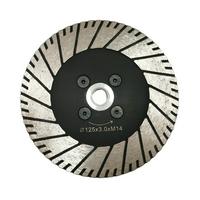
When a price change leads to a specification change, the substitution has to be detected. A 125 mm diamond blade for granite, marble and concrete is a useful benchmark item because its performance is easy to compare across batches, and a change in segment height or bond shows up in use. The diamond saw blade category lists the range so that a substitution can be checked against the contracted specification.
Safety
Cost pressure is a safety issue when it leads to a lower-specification product being supplied against a higher-specification order. Check the speed marking and the core condition on arrival, reject blades that do not match the agreed specification, and never fit a blade whose rpm rating is below the machine's no-load speed.