
 ES
A block that arrives at the yard is not square, not clean, and not uniform. Trimming is the operation that turns it into a reference, and everything downstream inherits the tolerance established here.
The work is done with large blades on heavy machines, but the principles are the same as on a bench: establish a reference, cut to it, and check before proceeding.
Why trimming matters more than it looks
A slab sawn from a block that was not squared will be tapered. That taper is then carried into every piece cut from the slab, and by the time it reaches a countertop it appears as a joint that will not close.
Trimming is also where internal defects are revealed. A fissure, a clay pocket, or a hard inclusion that was hidden under the rough surface becomes visible after the first cut, and the block has to be re-assessed before further work. Cutting the whole block before inspecting the first face is how a yard turns a marginal block into waste.
Squaring the block
Start with the face that will become the reference. In a yard with a bridge or a gantry saw, the block is set on a bed and the first cut establishes a plane. That plane is then used to reference the second cut at 90 degrees, and the third at 90 degrees to both.
Check each cut before the next. A block that is 5 mm out on the first face will be more than 5 mm out on the third, because errors compound at each rotation. Measure the diagonal of each new face; equal diagonals mean the face is square.
Where the block is too large to rotate, the reference has to be established with a laser or a plumb line and checked at each end. That is slower but it is the only way on a block that stays in one position.
Machine and blade selection
Block saws are built for depth and for water volume, not for precision. A blade on a block saw has a large diameter, a deep segment, and a stiff core, and it is expected to cut through material with inclusions.
The blade has to match the stone. A hard, dense granite produces little abrasive swarf, so it needs a soft bond that wears back and keeps fresh diamond exposed; fit a bond that is too hard and the segments glaze, so the blade polishes the stone instead of cutting it. A soft, abrasive limestone or sandstone does the opposite: its gritty swarf would erode a soft bond and pull the diamonds out early, so a harder bond lasts longer. The distinction is the same one described in diamond tool bond matrix, applied at a larger scale.
Segment depth determines how much of the block can be cut in one pass. On a deep block, a blade that is barely deep enough will run its core in the kerf, which wears the core and can bend it. Allow at least a segment's depth of clearance, and prefer a blade that cuts in two passes to one that is at its limit.
For softer stone, raveling at the cut edge is the main problem, and the approach overlaps with sandstone and limestone cutting. For dense stone, heat is the problem, and the approach overlaps with slate and basalt cutting.
Water and slurry at yard scale
A block saw moves a lot of water and produces a lot of slurry. The water has to reach the full depth of the cut, not just the top, or the lower part of the blade runs dry and overheats. Check the flow at the blade, not at the pump.
Slurry handling at yard scale is a settlement and disposal problem rather than a bucket problem. The general principles are in wet cutting slurry management, scaled up: settlement pits, a clarified return, and a disposal route that does not discharge to a watercourse.
Reading the block
After the first cut, look at the sawn face for the signs that determine how the block should be used. A vein that runs across the block will appear on every slab. A fissure that is parallel to the cut will produce slabs that split later. A colour change across the face means the block will produce two distinct batches.
Mark the block and record the findings. A yard that knows which blocks are sound and which are risky can plan the cutting to put the risky material into less visible work.
Tooling for the yard
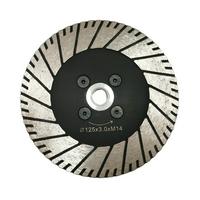
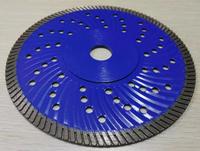
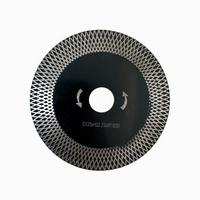
For trimming and squaring, a stiff blade with a deep segment is the priority. A 125 mm diamond blade for granite, marble and concrete is a bench tool rather than a block tool, but the same design logic applies at larger diameters, and the diamond saw blade category lists the range the yard needs for secondary cutting after the block is broken down.
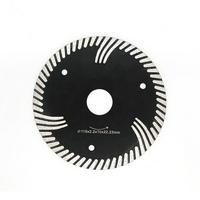
A diamond cutting disc for granite is useful for trimming the edges of slabs that have come off the block saw with a rough arris.
Safety
Block work involves heavy loads, large blades, and a lot of water. Isolate the machine before changing a blade, and never reach into the kerf to clear a blockage while the blade is turning. Wear eye and hearing protection, keep the guard in place, and check the blade's rpm rating against the machine. Keep the area around the saw clear of people, since a large blade failure throws fragments a long way.