ES
A trial order is not a small version of a real order. It is an experiment, and like any experiment it only produces useful information if the conditions and the pass criteria are set before it starts.
Most trial orders fail as experiments in one of two ways: they test too many SKUs at too low a quantity to reveal variation, or they test one SKU and assume the result generalises to the range.
Choose SKUs that represent the range
Diamond tool ranges vary along a few axes: diameter, segment type, bond hardness, and application. A trial should sample each axis rather than sample the catalogue.
A practical structure is three groups:
- The reference SKU. The highest-volume item in the range, because it is the one that will be reordered and the one whose failure is most expensive.
- The difficult SKU. The item with the tightest specification, whether that is a thin rim blade, a large diameter, or a hard-bond product. This is where a supplier's capability shows.
- The new SKU. Something the buyer has not sourced before, to test whether the supplier can hold a specification it has not made repeatedly.
Three to five SKUs is usually enough. More than that and the trial becomes an order with a test attached.
Quantities that reveal variation
One piece tells you whether the supplier can make a good sample. It does not tell you whether the production is consistent. Variation appears between pieces, so the trial needs enough pieces to see it.
A common structure is ten pieces per SKU: enough to cut with, enough to measure, and enough to keep one aside as a reference for the next batch. Five is the minimum for a meaningful spread; two is a sample, not a trial.
Where the item is expensive, reduce the number of SKUs rather than the quantity per SKU. Testing one item properly is more informative than testing five items superficially.
Pass criteria before shipment
The criteria have to be written down and agreed before the order is placed, because after shipment every disagreement becomes a negotiation. Four categories cover most of it.
- Dimensional. Diameter, bore, thickness, and segment height, with a stated tolerance and a stated measuring method.
- Marking. The speed rating, dimensions, and any required standard marking, verified against the specification rather than against the previous batch.
- Performance. A defined test: material, machine, cut length, and what counts as acceptable. "Cuts well" is not a criterion.
- Condition on arrival. Packaging integrity, corrosion, and flatness. A blade that arrives bent has failed regardless of its specification.
Include the sampling plan. If ten pieces arrive, how many are measured, and what happens if one fails. A criterion without a sampling rule produces an argument.
Run the trial under controlled conditions
A performance test is only comparable if the conditions are the same. Use the same machine, the same material, and the same operator for each candidate. Record the cut length, the time, the current draw if it can be measured, and the condition of the segment afterwards.
Photograph the segments before and after. Wear patterns are more informative than a verbal report, and the pattern is diagnostic: an uneven wear pattern points at a core or a bonding problem, and the reading method is in segment loss on diamond blades.
Where several suppliers are being compared, run the tests blind. An operator who knows which blade is which will produce the result they expect.
What to do with the result
A pass on one SKU is not a pass on the range. Scale up in stages: the reference SKU first, then the difficult one, then the rest. Each stage is a chance to catch a problem before it is multiplied by a container load.
A failure is also information. A trial that fails on marking but passes on performance tells you the supplier can make the product but not control the paperwork, which is a fixable problem. A trial that fails on dimensional consistency is a different message.
Documenting the trial
Keep one piece from each SKU sealed and labelled as the reference. When the next batch arrives, measure against it. This is the simplest form of incoming inspection, and it is more reliable than a specification sheet because it is physical.
The wider inspection routine is covered in quality inspection tips for electroplated diamond tools, and the commercial side of what happens when a batch fails is in warranty and claim handling.
Tooling notes
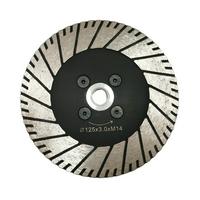
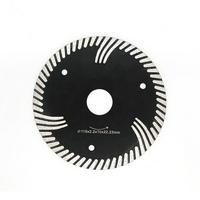
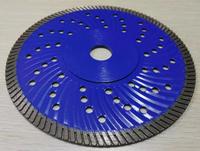
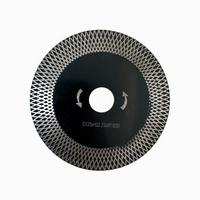
For a trial that includes tile work, a continuous rim blade for porcelain and ceramic tile exposes edge quality differences faster than a general-purpose blade, because chipping shows immediately. Include one if the range covers tile. The diamond saw blade category and the grinding disc category give the full set of categories to sample from.
Safety
Test cutting is still cutting. Wear eye and hearing protection, keep the guard fitted, and confirm the blade's rpm rating against the machine before every test. Inspect each trial piece for a distorted core or a damaged bore before mounting, and isolate the machine when changing blades.