ES
Crack chasing looks like a small job until the sealant fails a season later. Most of those failures start at the saw: a kerf that is too narrow, too shallow, or too ragged for the sealant to bond to. The blade is doing structural work here, not just opening a groove.
What a crack chasing blade actually is
A crack chasing blade is a small-diameter diamond blade with a narrow kerf, usually run on a handheld grinder or a purpose-built crack chasing saw. Kerf widths commonly fall between about 6 mm and 12 mm, and the segment profile is either flat or V-shaped.
The narrow kerf is the whole point. A general-purpose 115 mm or 125 mm blade removes far more material than the joint needs, wanders once it meets an irregular crack, and leaves feathered edges that spall away as the sealant flexes.
V-segment versus flat segment
V-profiled segments tend to self-center in a wandering crack, which helps on hairline cracks that change direction every few centimeters. Flat segments suit straighter chases and joints that have already been opened once. On a crack with a lot of lateral movement, the V profile does more of the guiding than the operator does, and that usually shows up as a more consistent groove width.
Match blade width to the joint design, not the crack width
Sealant joints are normally designed around a width-to-depth ratio near 2:1, with a backer rod filling the lower part so the sealant bonds only to the two sidewalls. That ratio sets the blade width.
If the crack itself is 3 mm wide but the joint needs to be 10 mm, the blade is a 10 mm blade. Chasing to the crack width leaves a joint that cannot accept enough sealant to stretch, and the repair tears out the first time the slab moves.
Check the specified joint width on the drawings before choosing a blade. On repair work where no drawing exists, measure a few existing joints on the same slab and copy the widest one.
Depth control is where most jobs go wrong
Depth is set by the sealant design, not by how deep the crack appears to run. A typical repair chase runs one to two times the joint width deep, enough to reach sound concrete and leave room for the backer rod.
Three practical controls make depth repeatable:
- Depth stop or guide shoe. A fixed stop beats judging depth by eye, especially on a long horizontal run.
- Score line first. A shallow pass along both edges gives the blade a track and reduces wandering.
- Two passes. Half depth, then full depth. One deep pass loads the blade and tends to pull the saw off line.
Run too shallow and the sealant sits on contaminated concrete. Run too deep and you cut into the slab's reinforcement zone or weaken the section for no benefit.
Dry or wet
Dry cutting is common on interior repairs because cleanup is easier with a dust extractor attached to the shroud. Wet cutting controls dust more reliably and keeps the segment cooler on long chases, at the cost of slurry that has to be contained and disposed of properly.
Either way, the dust is a crystalline silica hazard once the blade touches concrete. A shroud connected to a suitable extractor, plus a respirator rated for the exposure, is the baseline. Safety glasses and a face shield matter here because a narrow kerf throws fines straight back at the operator.
Common mistakes
- Using a standard masonry disc because it is already on the grinder. The kerf is too wide and the edges ravel.
- Cutting dry with no extraction, then blowing the dust out of the joint with compressed air. That just redistributes it.
- Leaving loose material in the groove. The sealant bonds to dust instead of concrete.
- Chasing over a spalled edge without removing the loose concrete first, so the new sealant has nothing solid to grip.
Choosing a blade for the job
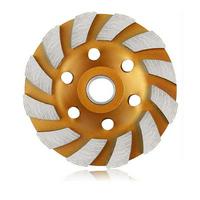
For general repair work, start from the diamond saw blade category and narrow down by kerf width and segment profile. General-purpose concrete blades such as this concrete and granite cutting blade handle the wider chase work, while a turbo-rim circular blade covers straighter runs where a clean edge matters more than self-centering.
Two related reads are worth the time: heat buildup in diamond cutting explains why a narrow kerf overheats faster than a wide one, and the diamond tool troubleshooting guide covers what a glazed or wandering blade is telling you.
Before you cut
Confirm the specified joint width and depth, check the blade's RPM rating against the machine, fit the guard and dust shroud, and clamp or weight the slab section if it is isolated by the repair. If the crack crosses a structural joint or shows vertical displacement, stop and get an engineer's read before chasing it — a sealant repair will not fix a moving slab.
For blade width, segment profile, and depth options matched to your joint design, send the drawing details to our team and we will confirm which specification fits.