ES
Every floor grinding job has an edge problem. A planetary machine stops short of the wall, and whatever happens in that last strip decides whether the finished floor has a uniform border or a visible halo.
Why the edge looks different
The field is ground by a heavy machine at a constant speed with overlapping passes. The edge is ground by a smaller, lighter hand-held tool at a different angle, often by a different operator. Different tool, different pressure, different scratch pattern.
Under a coating, that difference shows as a band of different sheen or texture. Under a polished finish, it shows as a border that catches light differently from the field. Neither is a defect in the tooling; both are a mismatch in process.
Tooling for the edge strip
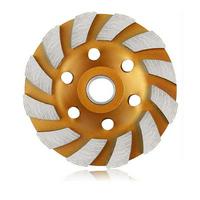
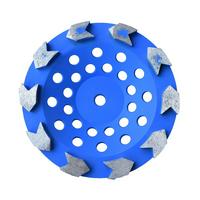
Hand-held 100 mm and 125 mm cup wheels are the standard edge tools, usually with a dust shroud that fits against the wall. The cup wheel diameter sets how close you can get; a 100 mm cup on a 100 mm grinder reaches closer than a 125 mm setup because the housing is smaller.
For the last few millimeters against a wall, an edge grinder with an offset head or a diamond hand block is the only option. These are slow, and that is why crews often leave the strip until the end and then rush it.
Matching the field
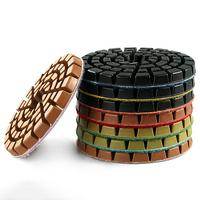
The edge should be taken through the same grit steps as the field, with the same tooling type where possible. If the field is finished with a resin pad, the edge should not stop at a metal-bond scratch.
Overlap the edge work into the field by 100 to 150 mm so the transition is gradual. A hard line between edge and field is more visible than a gradual change in texture.
Dust at walls
Shrouds do not seal well against a wall, and the dust that escapes tends to travel up the wall and settle on surfaces the client cares about. Masking the lower wall, using a shroud with a brush skirt, and running the extractor at full flow makes a visible difference.
On a job where the wall is finished and cannot be marked, hand grinding with a wet sponge or a low-dust blade may be the safer choice even though it is slower.
Columns and penetrations
A column creates a ring rather than a strip. Working around it in one direction leaves a start and finish mark where the passes meet, so plan the pass to finish in a corner or against a wall where the overlap is least visible.
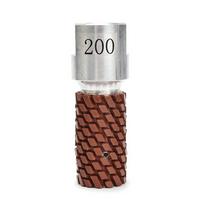
For pipes and penetrations, a small-diameter cup wheel or a diamond core bit used as a grinding head can reach areas a standard cup cannot. Take care not to gouge the substrate around the penetration, because that is where coatings tend to fail first.
Common mistakes
- Leaving the edge until the machine work is finished, then grinding it with a worn disc.
- Using a different grit on the edge than on the field.
- Grinding the edge dry with no extraction and coating the wall in dust.
- Over-grinding the corner and creating a dip that shows under raking light.
- Not overlapping into the field, so the border is a hard line.
Tooling
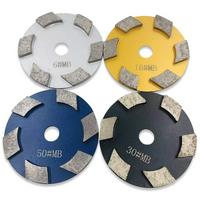
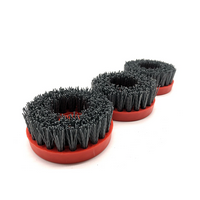
Start from the grinding disc category. A 100 mm diamond cup wheel is the standard edge tool, and an M14 coarse resin filled cup wheel covers the finer edge passes on stone and concrete.
Two related reads: dust control when grinding concrete, and 100 mm cup wheels for edge repair.
Safety
Edge work means working on knees with a tool close to the body. Wear knee pads, eye protection, a respirator, hearing protection, and gloves. Keep the guard fitted, match the cup's rpm rating to the grinder, and be aware that kickback against a wall has nowhere to go — keep a firm two-handed grip and never trap the tool between the floor and the wall.
If you are planning edge tooling for a large floor, send the machine model and the wall layout and we will confirm the cup sizes and grit steps.