ES
Terrazzo restoration looks like concrete polishing until the first pass. Then the difference appears: the matrix is softer, the chips are harder, and the tool has to cut both without digging out the aggregate the finish depends on.
What you are actually grinding
Terrazzo is a composite of marble, granite, glass, or quartz chips set in a cement or epoxy matrix. The two components have very different hardness. A tool that cuts the matrix comfortably will skate on the chips; a tool aggressive enough for the chips will gouge the matrix.
Cement-based terrazzo is porous and absorbs water. Epoxy terrazzo is denser and more sensitive to heat. The restoration sequence differs between them, and so does the bond choice.
Assessment before grinding
Walk the floor and map it. Look for hollow spots, cracks, delaminated areas, and patches of different terrazzo. Those areas behave differently under the machine and will show as uneven gloss if they are not addressed first.
Check whether the floor has a sealer or a wax coating. Old wax has to be stripped before grinding, or the tool will load and smear it across the surface.
Grinding plates and bond
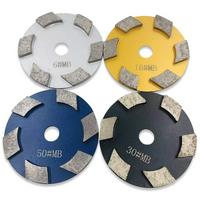
Coarse metal-bond plates level the floor and remove the old finish. On cement terrazzo, a medium bond is usually a reasonable starting point; on epoxy terrazzo, a harder bond resists the heat that a soft bond would generate.
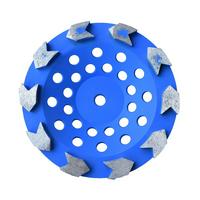
Segment count matters here as much as on concrete. More segments give a flatter, more uniform cut, which matters because terrazzo's visual quality depends on the chips being cut flush rather than torn.
The grit sequence
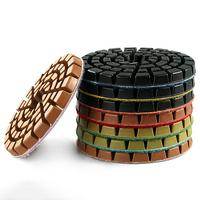
A typical restoration runs from coarse metal through a series of resin steps, then a final polish. The exact grits depend on the condition of the floor and the finish required, but the principle is the same as any polishing sequence: each step must remove the previous scratch completely.
On terrazzo, the check is visual as well as tactile. Under raking light, the surface should show an even distribution of chips with no directional scratch. A patchy gloss usually means a step was skipped or the floor was not flat before polishing started.
Over-exposing aggregate
Grinding too aggressively removes matrix and leaves chips standing proud. The floor then has a rough, pitted look that no amount of polishing will fix, and the only remedy is to grind further and lose more surface.
Light passes, multiple times. The goal is to expose the chips evenly at the surface, not to cut down to them.
Patch repair before polishing
Cracks and spalls should be repaired with a matching mix before the final grinding stages, not after. A patch ground flush in the sequence blends far better than one cut back afterwards.
On cement terrazzo, the patch needs enough cure time to behave like the surrounding floor under the tool. Grinding a green patch usually pulls material out of it.
Common mistakes
- Grinding a waxed floor without stripping first.
- Using a concrete polishing sequence without adjusting for matrix hardness.
- Skipping the flattening stage and trying to polish an uneven floor.
- Running resin tools too fast on epoxy terrazzo, which softens the surface.
- Repairing cracks after polishing, leaving a visible patch.
Tooling
Start from the grinding disc category. A diamond floor grinding block handles levelling and coating removal, and a floor polishing pad carries the finishing stages.
Two related reads: concrete floor preparation tools, and avoiding swirl marks when polishing.
Safety
Terrazzo dust contains silica from the chips as well as the matrix. Use a shroud and extractor, a respirator rated for the exposure, eye and hearing protection, and gloves. Disconnect the machine before changing plates, and check that plates are seated flat — a loose plate on a terrazzo floor leaves a gouge that cannot be polished out.
If you are restoring a terrazzo floor of unknown composition, send photos and the approximate area and we will confirm a plate and grit sequence.