ES
An automatic polishing line is a factory, not a workshop. Once a slab enters the line, every head has a fixed job and the operator's influence drops to a few settings. That makes abrasive consistency more valuable than cutting speed: a single head that behaves differently from its neighbours leaves a band on the slab that cannot be polished out downstream.
The Frankfurt format
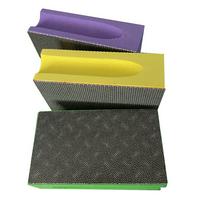
Frankfurt abrasives are rectangular blocks that mount in the polishing heads of a bridge or line polisher. The format is a standard for slab finishing, which is why it persists: heads are built around it, and a change of supplier does not require a change of machine.
Traditional Frankfurt blocks use silicon carbide or aluminium oxide abrasive. Diamond Frankfurt blocks carry diamond grit in a resin or metal matrix, which gives a more consistent cut across the block's life and holds the specified grit more accurately.
Grit sequencing on a multi-head line
A polishing line has a fixed number of heads, and the sequence is assigned across them. A typical arrangement starts with coarse diamond or silicon carbide to remove saw marks, moves through a series of intermediate grits, and finishes with fine abrasives that develop gloss.
The constraint is head count. If a line has ten heads, every grit in the sequence has to earn its place. Skipping a grit to add a finer finish step is a common compromise, and it usually shows as a faint scratch pattern in the finished slab rather than as an obvious defect.
Where a line is short on heads, the practical answer is to slow the line rather than to compress the grit sequence. Slower line speed gives each head more time, which is the same effect as adding a step without changing the tooling.
Head pressure and oscillation
Pressure settings determine how much work each head does. Too little and the abrasive glazes; too much and the slab can chip at the edges or the head can stall. The correct setting is usually the one that produces a consistent scratch across the full slab width, checked at both edges and the centre.
Oscillation spreads wear across the block face and reduces the chance of a head leaving a line. A block that has worn into a groove will keep cutting that groove, so rotating or replacing blocks on a schedule matters more than replacing them when they look worn out.
Water flow
Water cools the head, flushes slurry, and carries away cuttings. On a line polisher, water is delivered to each head, and flow that is adequate at the first head may be insufficient at the last as nozzles clog.
Check flow at the final heads first. A starved finishing head heats up, glazes, and leaves a dull band that operators often misdiagnose as a grit problem.
Matching blocks to the stone
Hard, dense marble requires a softer matrix so the diamonds stay exposed. Softer, more absorbent stone requires a harder matrix so the block does not wear away before the diamonds have done their work.
This is the same logic as any diamond tool, but the consequences are larger on a line because a wrong choice affects a whole production run rather than one floor.
Common production problems
- Bands across the slab: one head cutting differently from its neighbours, usually a pressure or wear issue.
- Edge chips: too much head pressure at the slab edge, or a slab that is not supported flat.
- Dull finish at the last heads: water starvation or glazed blocks.
- Inconsistent gloss between slabs: blocks at different wear stages across the line.
Tooling
For line work, the polishing tools category covers the abrasive and pad options. A diamond marble polishing pad is the hand and edge equivalent of a line abrasive, and a flexible resin abrasive pad suits curved and profiled surfaces that the line cannot reach.
Two related reads: wet versus dry polishing pads, and diamond grit size explained.
Safety
Line polishing is wet work with rotating heads. Keep guards and interlocks functional, never reach into a running head, and isolate the line before changing blocks. Slurry is slippery and can dry into a fine dust that is a respiratory hazard during cleanup — use extraction or wet cleanup rather than dry sweeping.
If you are specifying blocks for a line, send the head count, line speed, and stone type and we will confirm the grit sequence and matrix.