ES
Monument work is a small industry with unusual demands. The pieces are thick, heavy, and often polished on every visible face. A burn mark on a kitchen countertop can be blamed on the material; on a black granite headstone it is the first thing anyone sees.
What makes memorial work different
The stock is thicker than a countertop slab, often 100 mm to 200 mm, which changes the saw and the handling. The faces are large and flat, so polishing has to be consistent across a big area. And the finish is usually a high polish on dark stone, which shows every variation.
Lettering is a separate process — sandblasting through a rubber stencil is common — but the surface has to be prepared for it. A polished face with an uneven scratch pattern will show through the lettering recess.
Cutting and shaping
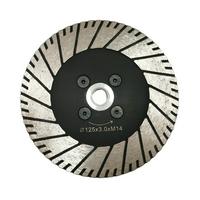
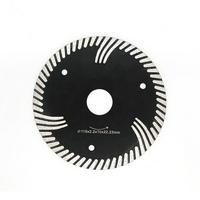
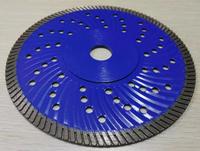
Thick blocks need a saw with enough depth and a blade with the rigidity to stay true through the cut. On a bridge saw, the blade choice is about the stone and the finish required at the cut face; on a hand-held saw, it is about control and water supply.
Shaping the top — a serpentine or a pitched edge — is done with a profile wheel or a hand tool, then refined. On granite, a vacuum brazed wheel removes material quickly; the finishing passes need a finer tool to avoid leaving a scalloped surface.
Polishing large faces
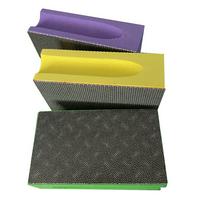
A 100 mm cup wheel on a variable-speed polisher is the standard tool, worked in overlapping passes across the face. The grit sequence runs from coarse to fine, and the check is the same as anywhere else: raking light, dry surface, no directional scratch before moving on.
On dark granite, heat is the enemy. A pad run too fast or with too much pressure leaves a haze that looks like a scratch but is a resin smear. Reduce speed and keep water flowing before adding a finer grit.
Edges and mouldings
Edge profiles on memorials are often deeper than on countertops. A profile wheel forms the shape, and hand pads refine the transition where the profile meets the face. That transition is where a machine finish reads as a hard line.
Holes and fittings
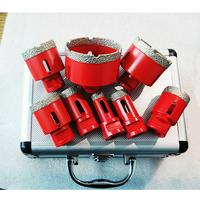
Vase holes, pin holes, and fixing holes are cored with diamond core bits. On granite, a vacuum brazed bit with water is the usual choice, and the risk is blow-out at the exit. Drill from one face until the pilot breaks through, then complete from the other side where the geometry allows.
Handling
A polished 200 mm granite block is heavy and unforgiving. Lifting equipment, a proper A-frame, and two people are not optional. Most damage in a memorial shop happens during handling, not during cutting.
Common mistakes
- Polishing a large face in one direction, leaving a visible grain.
- Running pads too fast on dark granite and creating a heat haze.
- Skipping grits because the face is large and the schedule is short.
- Cutting thick stock with a blade that is too small for the depth.
- Handling polished pieces without protection, chipping an edge that then needs re-polishing.
Tooling
For the work, the grinding disc category covers shaping and grinding. A 75 mm vacuum brazed hand wheel shapes edges and mouldings, and a 100 mm cup wheel handles face work and flattening.
Two related reads: essential diamond tools for granite shaping, and polishing granite edges.
Safety
Granite dust contains crystalline silica. Wet working is the default, with a respirator for dry operations and cleanup. Wear eye protection, hearing protection, and gloves, use RCD protection on wet tools, and never lift a polished block without a rated sling or clamp.
If you are setting up a memorial shop and need a tool list for thick granite work, send the typical dimensions and finishes and we will advise.