
 ES
Porcelain tile is the awkward customer of diamond blades. It is denser and harder than ceramic, it is brittle right at the glaze, and it barely abrades the diamond at all. That combination is why a blade that behaves well on ceramic can feel dull on porcelain within a few cuts: there is not enough abrasive slurry at the rim to keep wearing the bond back and exposing fresh diamond.
The decision therefore comes down to three things rather than diameter — how the rim is built, how hard the bond is, and how the blade is cooled and fed.
Why porcelain is not just harder ceramic
Porcelain is pressed at higher density and fired at a higher temperature than standard ceramic. That leaves it harder, less porous and less abrasive to the blade. Two consequences matter when you are picking a product.
First, the cut produces very little fine abrasive dust, so a hard bond has nothing to wear against and tends to polish over instead of shedding. Second, the tile is more brittle at the surface, which means any lift, wobble or grab at the entry and exit of a cut shows up as a chip along the glaze.
What that means on the jobsite
A blade intended for porcelain usually pairs a softer bond with finer diamond, so the matrix wears back at a rate that keeps opening new diamond. Fit a hard-bond blade built for concrete onto porcelain and you should expect slow cuts and a shiny, glazed rim after a short run.
Rim type: which one actually helps the edge
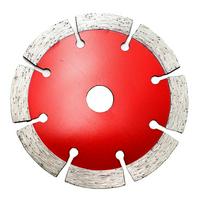
Continuous rim blades are the usual starting point for tile, because a continuous edge supports the cut line across its whole length and tends to leave a cleaner edge than a segmented rim. Segmented blades clear debris faster and suit concrete and masonry, but the gaps in the rim can lift the tile slightly and produce more chipping on glazed porcelain.
Turbo and mesh rims sit between the two. They are thinner than a segmented blade, they clear slurry better than a plain continuous rim, and they cut faster than a fine continuous blade. For porcelain that has to be cut quickly and still look clean, a thin turbo or mesh rim on a wet saw is a common compromise.
None of these rims removes chipping entirely. Chip size depends on the material, the feed rate, the machine, the water supply and the condition of the blade. Treat rim design as one variable among several, not as a guarantee.
Bond hardness is the part buyers skip
Bond hardness decides whether a blade still cuts on the twentieth metre. A hard bond holds diamond longer, which suits abrasive materials such as green concrete or asphalt, where the material itself keeps the diamond exposed. A softer bond releases worn diamond sooner, which is what dense, low-abrasion porcelain needs.
The practical question to put to a supplier is not "is this blade good for tile" but "which bond do you recommend for porcelain, and why". A supplier who can answer that is easier to work with than one who quotes only a diameter and a price.
Thin kerf, arbor fit and machine load
A thinner blade removes less material, so it loads the motor less and generally produces a narrower, cleaner cut. On a small wet saw or a low-power angle grinder, matching a thin kerf to the available power matters more than buying the widest blade that fits.
Check the arbor bore against the machine spindle. A 22.23 mm bore is common on tile blades, but confirm it rather than assuming, because an arbor mismatch is a returned item rather than a warranty conversation. Also confirm the blade's rated speed against the machine's no-load speed in writing, for each size in the range you are buying.
Wet or dry cutting
Wet cutting controls heat at the rim, carries slurry away and helps hold the cut line. It also needs a machine with a water feed, and the water has to actually reach the cut; a trickle that misses the rim does very little. Dry cutting on porcelain is workable with a thin blade and light passes, but the blade then depends on airflow through the cut and on the operator not forcing it.
If a supplier describes a single blade as suitable for both wet and dry use, ask how the rim and bond differ between the two versions.
Feed rate, and why the first cut matters
Most chipping on porcelain comes from the operator, not the blade. Pushing the tile through faster than the blade can clear the kerf loads the rim, raises heat and lifts the tile at the exit. Let the blade cut at its own pace and keep the feed steady.
Cut a short test piece before committing to the full job. Look at the rim after the cut: if it looks polished and the blade has slowed noticeably, the bond is too hard for the material, the water supply is short, or the feed is too light.
What to confirm before ordering
For single purchases, the useful checks are specific rather than generic:
- Material and finish the tile has to match, not just "porcelain"
- Rim type and bond recommendation for that material
- Bore size and rated speed, in writing, per size
- Wet or dry operation, and what the machine actually supports
- Blade thickness, if motor power is limited
For importers and distributors building a range, add the questions that decide whether a repeat order runs smoothly: which sizes share a common bond, whether packaging can carry your own part numbers, what inspection happens before shipment, and how a specification change is communicated between orders. Confirm lead time, sample policy and payment terms with the supplier directly rather than carrying them over from another vendor.
Safety note: keep the guard fitted, wear eye and hearing protection and a dust mask, match the blade rating to the machine speed, and use the water feed or dust extraction the material requires. Follow the manufacturer's instructions for the specific blade and machine combination.
Where to go next
Start from the diamond saw blade range or the tile tools category to see the sizes and rim options available. Two products that come up often for this job are the porcelain and ceramic tile blade and the 115/125mm turbo mesh blade.
If chipping is the specific problem rather than blade selection in general, the notes on reducing chipping when cutting ceramic tile go further into technique, and the comparison of wet and dry cutting covers the cooling side.
To check whether a particular blade geometry fits your material and machine, send the tile type, the machine and the finish you need, and the fit can be reviewed against the available options.