ES
Large-format tile has made lippage a normal part of the conversation. A 1200 x 600 panel cannot follow a floor that is out by 3 mm over a metre, and the result is an edge that sits proud of its neighbour by a millimetre or two, which is enough to feel underfoot and to catch light.
There are two responses: grind the high edge down, or take the piece out and re-lay it. The choice is not purely technical. It depends on the tile, the depth of the lip, and what the surface has to look like afterwards.
Measuring the lip
Put a straight edge across the joint and measure the step with a feeler gauge. Measure at several points along the joint, because lippage is rarely uniform; a tile that is high at one corner and low at the other has a bedding problem, not a flatness problem.
Record the direction of the lip. If the high edge is on the tile that is easier to remove, re-laying is more attractive. If the high tile is in the middle of a field with ten others around it, grinding may be the only practical option.
Standard tolerance for lippage in large-format work is usually expressed as a fraction of the joint width, and the project specification is the authority. On a 2 mm joint, a 1 mm lip is already half the joint, which is visually significant.
Grinding: what it costs you
Grinding a lipped edge means removing glaze. On a through-body porcelain, the body colour usually matches closely enough that the repair is nearly invisible. On a glazed tile, the body is a different colour, and grinding exposes it. That is the single most important fact in the decision.
Grinding also changes the edge geometry. A square edge becomes slightly rounded, which shows as a wider joint line under raking light. On a polished tile, the ground edge will not take a polish that matches the face.
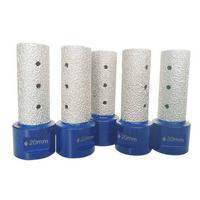
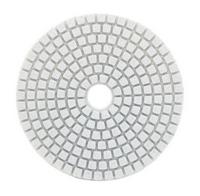
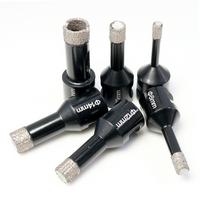
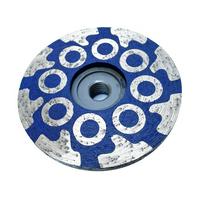
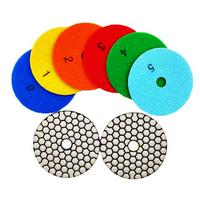
Where grinding is appropriate, use a fine diamond pad on a variable-speed polisher, work along the edge with the pad flat, and remove the minimum. A cup wheel is too aggressive for this; it will take the glaze off in a band rather than at the edge. A resin filled cup wheel is the better choice when a small amount of material has to come off a hard surface without gouging, and a hand pad finishes the arris.
Re-laying: what it costs you
Re-laying is more disruptive but gives a correct result. The piece comes out, the bed is corrected, and the tile goes back. The risks are damaging neighbouring tiles and damaging the waterproofing or the underfloor heating.
The decision usually comes down to area. A single lipped tile in a field of twenty is worth re-laying if it can be removed cleanly. A lipped edge along a whole wall is a bedding problem that grinding will only hide.
If the tile is being re-laid, fix the cause. A lippage that reappears on the replacement means the substrate is not flat, and the correct fix is to level the substrate rather than to keep replacing tiles. The measurement method for the substrate is the same as for a finished floor, covered in floor flatness and lippage checks.
Prevention is cheaper than either
Most lippage is created before the first tile is laid. A substrate that is flat within 3 mm over 3 m, a notched trowel that matches the tile size, and a back-buttered tile will produce a flat field. Large-format tile needs full bed coverage, and a tile that is only touched at the corners will rock.
Lippage control systems, meaning clips and wedges that hold adjacent tiles level while the adhesive sets, are the standard defence. They do not fix a bad substrate, but they prevent the small differences that come from a tile settling while the next one is placed.
Check as you go. A straight edge laid across the last three tiles will show a developing lip before it becomes a field-wide problem. Correcting one tile is cheap; correcting twelve is a re-lay.
After the repair
A ground edge needs sealing if the tile is porous, and it needs the joint refilled because grinding removes grout at the edge. A re-laid tile needs the joint refilled and the surrounding joints checked for damage from the removal.
Check the finish after the repair, not just the flatness. A repair that is flat but visually different is still a defect, and the standard for sheen is the same as for any polished surface, described in gloss units on polished stone.
For the tooling side, a grinding disc matched to the tile hardness makes the difference between a controlled dressing and a gouge. The grinding disc category lists the options, and a diamond floor grinding block is the appropriate tool when a whole floor has to be brought flat rather than a single edge dressed.
Safety
Grinding installed tile produces fine dust in an occupied space. Use extraction, wear a respirator, and isolate the area. Wear safety glasses, keep the tool's speed within the pad rating, and use residual current protection with a wet polisher. When removing a tile, wear gloves and safety glasses; porcelain breaks into sharp fragments.