ES
A brown bloom around a fixing is one of the most common callbacks on stone work, and one of the most commonly mistreated. Cleaning the surface removes the visible stain and leaves the source in place, so the stain returns within weeks.
Rust on stone has three possible sources: a ferrous fixing that is corroding, iron minerals in the stone itself, or contamination from tools and water. Each needs a different response.
Finding the source
Look at the pattern. A stain that radiates from a fixing is coming from the fixing. A stain that follows a vein or a bedding plane is mineral, from within the stone. A stain that appears in a line along a wall or a floor is usually contamination, from a steel tool, a wire brush, or water that has run over ferrous metal.
Then look at the fixing. A screw or a bracket that is rusting will show corrosion at the head or at the fixing point. If the fixing is hidden, remove the cover and inspect. On exterior work, galvanised or coated fixings can still corrode at a cut edge.
Water is the accelerant. A fixing that stays wet will corrode far faster than one that dries, which is why rust staining is so common around showers, planters, and exterior sills. Fixing the water path is part of fixing the stain.
Removing the stain without making it worse
Rust removers are acidic, and acid etches marble and limestone. On a calcareous stone, a general-purpose rust remover will remove the stain and leave a dull patch that then has to be polished.
The safer sequence is: test on an inconspicuous area, use the weakest product that works, apply to the stain only rather than flooding the surface, and rinse thoroughly. On a polished surface, keep the dwell time short and re-polish afterwards if the sheen changes.
For a light stain, a poultice is often better than a liquid. A poultice draws the stain out rather than dissolving it at the surface, which reduces the risk of driving it deeper. Apply, cover, leave, and remove; the timing depends on the product and the stone.
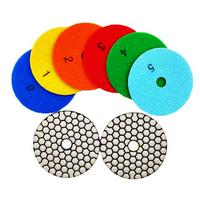
Mechanical removal is a last resort. A fine pad will remove a surface stain but not one that has penetrated, and it changes the finish, which then has to be blended.
Repairing the fixing
Removing the stain without addressing the fixing guarantees a repeat. Replace ferrous fixings with stainless or with a coated fixing appropriate to the environment. On exterior work, stainless of the correct grade is the default; a cheap coated screw will fail at the first scratch.
Isolate the fixing from the stone. Stone is not a metal, so there is no galvanic couple between a steel fixing and a slab; a small nylon washer or sleeve instead keeps rust and metal ions out of the stone pores and spreads the contact load so the head does not bear on a hard point. Where two different metals do meet, such as a stainless fixing into a carbon-steel frame, the same sleeve does break the galvanic path. On a wet area, seal the fixing head so water cannot sit against it.
Where a fixing is set into a hole, fill the hole with a resin or a grout that does not shrink, and cap it. A void around a fixing holds water, and water plus steel plus time equals rust.
Iron in the stone itself
Some stones contain iron-bearing minerals that oxidise over time, producing a bloom that has nothing to do with fixings. This is a material property, not an installation defect, and it can appear months or years after installation.
The stain can be treated, but it will recur, because the source is distributed through the stone. In visible work, the practical response is to select slabs without visible iron staining at the specification stage, and to keep the stone dry, since moisture accelerates oxidation.
Where the staining is already present and unacceptable, the only permanent fix is replacement. Treating it repeatedly is a maintenance programme, not a repair.
Cleaning tools that cause the problem
A wire brush with steel bristles will leave iron particles embedded in a soft stone, and those particles rust. The same happens with steel wool and with any abrasive that has been used on ferrous metal.
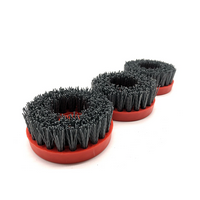
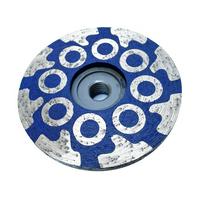
For stone, use a brush with stainless or synthetic bristles. The diamond masonry grinding brush is a texturing tool rather than a cleaning brush, but the same principle applies: the tool has to be compatible with the stone, not just with the task.
Water is a carrier too. Water that has run over rusty scaffolding, or that sits in a steel container, will deposit iron on the surface it wets. On exterior work, check the water source before blaming the stone.
After the repair
Re-polish the area if the cleaning dulled it, and match the surrounding finish. The reference for the finish is the same as for any polished surface, described in gloss units on polished stone. On a honed surface, stop at the grit that matches, as set out in honed vs polished marble.
If the stone also shows white bloom from salts, the diagnosis overlaps with efflorescence on ground concrete, and the two can occur together on a wet exterior job.
Safety
Rust removers are acids. Wear gloves and safety glasses, ventilate, and never mix with other chemicals. Use residual current protection if a wet polisher is used, and dispose of poultice waste responsibly rather than washing it into a drain.