ES
Most polishing problems blamed on the pad are really tool problems. A resin pad designed to work at a few thousand revolutions per minute behaves very differently at the eleven thousand or so that a standard angle grinder delivers. The resin overheats, the surface hazes, and the pad wears away before it has refined the scratch pattern.
The speed gap
A dedicated wet polisher typically runs in a low thousands of rpm band and is geared to keep torque there under pressure. An angle grinder is built to spin small abrasive wheels fast and free. Running polishing pads on a grinder without speed control pushes the pad beyond its design range, and the water feed cannot carry away the heat fast enough.
Where a grinder is the only tool available, a variable-speed model set to its lowest stable setting is workable for small edge jobs, but the operator has to watch both speed and pressure continuously. The rpm matching guide sets out how speed, diameter, and accessory ratings relate.
Water delivery changes the workflow
A wet polisher carries water through the spindle or through a hose directed at the pad centre. That keeps the interface cool and flushes the slurry out from under the pad instead of grinding it back into the surface. It also means dealing with runoff: a shroud, a wet vacuum, and a plan for where the water goes.
Angle grinders are usually dry tools. Adapting one for wet work introduces an electrical hazard near the motor and the supply, so an RCD-protected circuit and a tool rated for the conditions are not optional extras. If the job cannot support a proper water setup, dry pads on a suitable tool are the more honest choice; see the wet versus dry polishing pad comparison.
Backing pads and how the tool feels
A rigid rubber backer pad with a hook-and-loop face keeps the pad flat and distributes pressure. On a light, fast grinder the operator tends to tilt the tool, which loads one edge of the pad and leaves a crescent of unrefined scratches. A wet polisher has a broader head, a lower centre of gravity, and a side handle that makes a flat pass easier to hold.
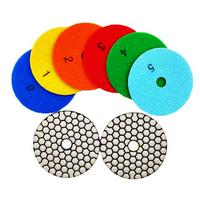
Pad flexibility matters too. A three-step hybrid pad is forgiving on a machine with some give, but it will still burn if the tool is running far above its intended speed and held in one spot.
Which one for which job
- Long floor runs and full polishing sequences. A wet polisher, or a floor machine with the right head, gives repeatable results across the whole area.
- Edges, sink cutouts, and small repairs. A low-speed variable tool with a small pad is easier to control in a confined space.
- Single-stage cleanup or a quick blend. A speed-controlled grinder can work, provided the pad is rated for it and the surface is kept cool.
- Vertical faces and stairs. Tool weight and hose management decide more than pad specification does.
Practical checks before starting
Confirm the pad's rated rpm against the tool's rating, fit the correct backer pad, check that water reaches the pad centre before the tool touches stone, and keep the cord and hose clear of the head. Review the polishing tools category to match pad type and diameter to the machine.
Wear eye protection, gloves, and hearing protection, and use an RCD-protected supply for any wet work. Keep the guard fitted where one is provided, and let the pad do the work rather than leaning on the tool to force a faster result.