
 ES
Calibration is the least glamorous step in a stone shop and the one that decides whether everything downstream fits. A slab that varies in thickness by a millimetre will produce a mitre joint that steps, a countertop that rocks on its cabinets, and an edge profile that looks different at each end.
What calibration does
Calibration grinds one or both faces of a slab to a uniform thickness using a machine with diamond cylinders or a wide belt. It removes saw marks, levels the surface, and establishes a known thickness that the rest of the process can rely on.
It is not polishing. A calibrated surface is flat and consistent, but it is still matte and may carry a fine scratch pattern that later stages remove.
Why thickness tolerance matters
Countertop fabrication assumes a constant thickness. Cabinet rails, edge build-ups, and mitre joints are all designed around a nominal dimension. When the slab varies, the fabricator compensates with shims and adhesive, and the compensation shows.
On a mitre, a thickness difference between the two halves produces a visible step at the joint. On an undermount sink, it changes the reveal. On a linear drain or a flush-mounted hob, it changes the finished floor level.
How much to remove
Remove as little as necessary to reach a consistent surface. Every pass consumes material, and on a thin slab or a rare stone, excess removal reduces the finished thickness below what the job allows.
Measure before and after. A digital calliper at several points across the slab gives a map of variation, and that map decides how much the machine has to take off.
Checking the machine
Calibration is only as good as the machine's setup. Worn cylinders, uneven belt tension, or a table that is not level produce a slab that is thin in one area and thick in another.
Run a test piece and measure it at the corners and centre. A wedge-shaped result points to a table or head alignment problem, not to the stone.
Calibration before profiling
Profile the edge after calibration, not before. A profile cut into a slab that is later reduced in thickness will have the wrong depth, and the edge will need to be reworked.
The same applies to polishing: a calibrated face polishes evenly, while an uncalibrated face develops patches where the tool is cutting more or less material.
Common mistakes
- Profiling first and calibrating afterwards.
- Removing more material than necessary to save a pass.
- Measuring one point and assuming the slab is uniform.
- Skipping the test piece after a machine adjustment.
- Calibrating a slab that has not been inspected for cracks or voids.
Tooling
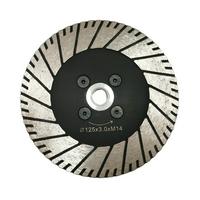
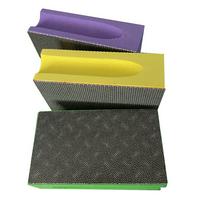
For the grinding side, the grinding disc category covers the options. A diamond grinding block handles smaller calibration work and surface levelling, and a sintered bowl grinding wheel covers heavier stock removal.
Two related reads: sintered bowl grinding wheels, and bond hardness explained.
Safety
Calibration generates a large volume of stone slurry and dust. Use the machine's water feed and extraction, wear a respirator where dust is present, and keep hands clear of the rollers. Isolate the machine before changing or inspecting cylinders, and clean slurry from the floor before it dries into a slip hazard.
If you are calibrating slabs for a specific finished thickness, send the nominal size and current variation and we will advise on tooling and passes.