
 ES
A cold storage floor has to stay flat under heavy racking loads, resist thermal cycling, and work with a vapour-tight build-up. Preparation is where those requirements are won or lost, and it has to be done under temperature conditions that affect both the slab and the tooling.
Three constraints that interact
Moisture control comes first. A cold room creates a strong vapour drive from the warmer side of the structure, so the slab condition and the vapour barrier detail matter before any coating or finish is considered. Grinding opens the surface and changes its vapour transmission; doing that before the moisture position is understood can create problems that only appear after the room is brought down to temperature. The surface profile guide explains how preparation affects what a subsequent layer can bond to.
Flatness is second. Very narrow aisle racking and automated handling place tight demands on surface regularity, and grinding has to be planned from a measured baseline rather than applied uniformly. Thermal movement is third: joints, insulation interfaces, and door thresholds all move differently, and a rigid preparation detail across them can crack later.
Racking and point loads
Mark racking leg positions and any planned fixed equipment before the flatness survey. Those points carry concentrated loads and are where a small local deviation matters most, even when the overall floor reads well. Agree whether the tight tolerance applies to the whole slab or specifically to the racking aisles, since that decision changes how much material has to be removed.
Practical preparation sequence
- Survey before grinding. Mark highs and lows with a straightedge and a numbered grid.
- Confirm the slab condition. Test moisture and check for existing coatings, curing compounds, or contamination.
- Control the environment. Work before the room is brought to operating temperature where the programme allows, and account for condensation as conditions change.
- Choose the removal method. Coatings and laitance need aggressive metal-bond tooling; refinement needs a lighter sequence.
- Vacuum between stages. Residual dust left in the profile weakens the bond of whatever follows.
The terrazzo restoration guide is a useful comparison for a decorative floor where aggressive removal has to be balanced against preserving the surface.
Working in a chilled space
Condensation forms quickly when warm, moist air meets a cold slab. Keep the work area ventilated in a controlled way, and schedule grinding when the surface temperature is stable. Hoses, slurry, and wet-vac contents can freeze if the room is already down to temperature, so dry methods with effective extraction are often more practical than introducing water.
Coordination with other trades
Preparation sits between the structural slab, the insulation build-up, the vapour barrier, and the refrigeration installation. Agree the sequence and the handover condition with those trades before grinding begins, particularly around door thresholds and penetrations. A well-prepared floor can still be compromised by later drilling through the finished vapour layer.
Tooling and safe practice
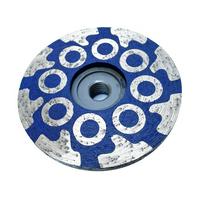
Browse the grinding tools category for tooling by machine. Diamond floor grinding blocks open a dense surface under a planetary head, and an arrow-segment disc takes down marked high spots on a lighter machine.
Maintain dust control on every pass, wear eye protection, a respirator rated for the exposure, and hearing protection. Confirm rated rpm on each disc and isolate the machine before changing tooling.