ES
A polished floor can look sound on handover and then develop whitening, dark patches, or a failing sealer a season later. In many of those cases the polishing was fine and the slab was simply too wet when the work started.
Why moisture matters here
Grinding opens the surface and increases its vapour transmission. Densifiers, sealers, and guards applied over a slab that is still drying can trap moisture below the treated layer. The result shows up as clouding, efflorescence, or a bond failure that is expensive to correct because the finish has to come off first.
New slabs, slabs without an effective vapour barrier, and floors that have been washed or exposed to weather all deserve a measurement rather than an assumption based on age. Calendar time alone is a poor guide: a thick slab in a cool, poorly ventilated building dries far more slowly than the same mix in a warm, dry one.
Common test approaches
- Plastic sheet test. A quick qualitative check for surface dampness. Useful for screening, not for a documented decision.
- Electronic moisture meter. Fast for scanning a large area and finding wet zones, but reads near-surface conditions and is sensitive to aggregate and reinforcement.
- In-situ relative humidity probe. Measures conditions at a defined depth in the slab and is the most informative for a finish decision. Requires drilled holes, equilibration time, and calibrated probes.
- Calcium chloride test. Estimates vapour emission at the surface. Sensitive to surface preparation and to site temperature and humidity.
Whichever method is used, record the location, depth, ambient conditions, and date. A single reading in the middle of a bay says little about a wet edge near an external wall.
Where to test
Place test points where moisture is most likely to persist: near external walls, over columns, in the centre of large bays, and beside any area that has been washed or recently exposed. A slab with a compromised vapour barrier often shows a clear gradient rather than a uniformly high reading.
Repeat the measurement once the building is in its normal operating condition. A floor tested with the heating off and the doors open can read very differently after the building is closed and occupied. If the schedule does not allow a second round, say so in the record rather than presenting a single snapshot as a settled result.
Connecting the result to the work
If the slab is outside the finish manufacturer's stated range, the options are to wait, improve drying conditions, or select a system tolerant of the measured moisture level. Grinding alone does not dry a slab. The surface profile guide explains how preparation affects coating bond, and the concrete countertop polishing sequence shows where densifier timing sits in the process.
Tooling and site practice
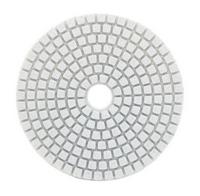
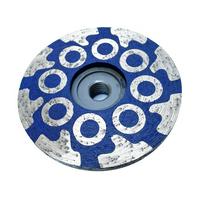
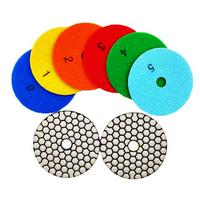
Once the slab is cleared for work, diamond floor grinding blocks open the surface, and a resin bond sanding disc refines it before any chemical treatment. Review the grinding tools category for holders and grit ranges.
Maintain dust control throughout, wear eye protection and a respirator rated for the exposure, and keep hearing protection on for machine work. Isolate equipment before changing tooling and confirm rated rpm on every disc.