
 ES
Diamond blades cut ductile iron well, but not for the reason most operators expect. Iron does not wear the diamond away the way concrete does. It reacts to heat and pressure, and a blade pushed too hard will polish its own matrix and stop cutting while the pipe edge turns blue.
Why iron behaves differently from concrete
Concrete is abrasive: it grinds the metal matrix away and exposes fresh diamond. Iron is tough and ductile. It deforms under the segment instead of fracturing, and the friction generates heat fast. Once the segment face is hot enough, the matrix smears and the diamonds sit buried in a glazed layer.
The practical consequence is that feed pressure has to be light and constant. Heavy pressure on iron produces heat, heat produces glazing, and glazing produces the slow, smoking cut that operators then try to fix with more pressure.
Rim choice
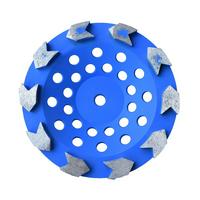
For pipe work, a continuous rim gives the cleanest cut and the least snagging. Segmented blades cut faster in the first few centimeters, then tend to catch on the pipe wall as the cut deepens, especially on thin-wall ductile iron where the segment can hook the far side.
A turbo rim sits between the two: open enough to clear debris, closed enough to avoid catching. On cast iron soil pipe, which is brittle and prone to cracking, a continuous rim with light feed is the safer default.
Cement lining is the hidden constraint
Most ductile iron water pipe carries an internal cement mortar lining. Heat from the cut travels through the pipe wall and can damage that lining near the cut edge, which shows up later as tuberculation or lining spalling at the joint.
Water cooling is the control. A steady water feed at the cut keeps the wall temperature down and flushes iron particles out of the kerf. Dry cutting iron pipe is possible on small diameters, but it is the fastest route to a damaged lining and a glazed blade.
Clamping before cutting
A round pipe on two supports will rotate. The blade catches, the pipe turns, and the saw kicks. Every pipe cut should start with the pipe blocked or clamped against rotation, and the saw supported so the operator is not holding the full weight of the tool at arm's length.
On a pipe already connected to a system, confirm it is drained and isolated before cutting. Residual pressure will pinch the blade and can burst the disc.
Reading the cut
- Bright, free-cutting chips: normal.
- Dark, fine dust and a blue edge: too much pressure or too little water. Back off and increase cooling.
- Blade stops advancing but keeps spinning: glazed. Dress it in abrasive material or replace it; more pressure will not recover it.
- Vibration and grabbing: pipe not secured, or a segmented rim catching the far wall.
After the cut
Deburr the cut edge before assembly. Push-on and mechanical joints rely on a clean, chamfered end, and a burr left by the blade will roll the gasket during assembly. A hand file is usually enough; a grinder risks removing too much wall thickness if the operator is in a hurry.
Check the lining at the cut and repair it with a suitable mortar if it has been damaged. A joint that leaks later is often a lining problem that started at the saw.
Blade and machine setup
Start from the diamond saw blade category and filter for continuous or turbo rims. A general purpose diamond blade handles utility work, while an electroplated thin disc suits small-diameter pipe and finish cuts where kerf loss matters.
Two related pieces: matching RPM ratings to the blade, and reading blade labels and markings — both matter more on metal than on masonry, because overspeed is the failure mode that hurts.
Safety
Iron cuttings are sharp and hot. Wear a face shield rather than open glasses, plus hearing protection and cut-resistant gloves. Keep the guard on, match the blade's maximum RPM to the machine, and never cut a pipe that is not restrained. On potable water work, keep cutting lubricant and slurry out of the pipe interior.
If you need a blade specification for a specific pipe diameter, wall thickness, and lining type, send the details and we will confirm the rim and bond that fit.