ES
Cladding work moves the cutting from the workshop to the scaffold. That changes the tools, the dust control, and the tolerance: a panel cut in a shop can be trimmed and refitted, while a panel cut on a facade has to be right the first time because the next one is a lift away.
Materials on a facade
Facade panels include porcelain and sintered stone, fibre cement, natural stone, and composite products. Each behaves differently under a blade. Porcelain and sintered stone are dense and brittle; fibre cement is abrasive and dusty; natural stone varies by type; composites can delaminate.
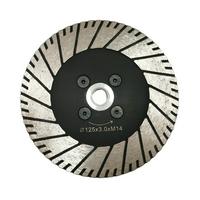
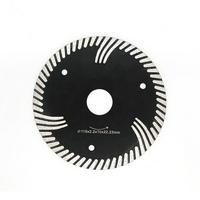
One blade for all of them is a compromise. A thin continuous rim blade suits porcelain and sintered stone; a harder bond with open gullets suits fibre cement; a general purpose blade handles natural stone.
Blade choice for on-site work
On a facade, the blade is usually on a hand-held saw with a guide rail. A thin kerf reduces the load on the saw and the dust volume, which matters when the saw is being held overhead.
Blade condition matters more on site because there is no bench to re-cut on. Carry a spare, and change a blade that has started to chip rather than finishing the elevation with it.
Open joints and tolerance
Rainscreen and ventilated facades are designed with open joints. The joint width absorbs tolerance, but it also exposes the cut edge. A ragged edge is visible in a way it would not be behind a sealed joint.
Cut from the face side where the blade rotation supports the edge, and support the panel so it cannot flex as the blade exits. On thin panels, a sacrificial board behind the cut reduces break-out.
Dust control at height
Cutting overhead sends dust down onto the operator's face and into the air around the scaffold. A shroud with extraction is difficult to manage at height but not impossible; a water-fed saw is often more practical because the slurry can be contained at the cut.
On fibre cement, the dust is a serious silica exposure. Dry cutting without extraction on a scaffold is the wrong method, regardless of how much faster it is.
Fixings and penetrations
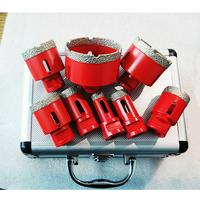
Facade panels need holes for fixings, brackets, and services. Diamond core bits and hole saws are used on porcelain and stone panels; on fibre cement, a hole saw or a step drill works. Support the panel and drill from the face to reduce breakout on the visible side.
Seal cut edges and penetrations according to the system design. An unsealed edge on a fibre cement or composite panel absorbs water and fails early.
Common mistakes
- Using one blade for every panel material on the elevation.
- Cutting from the back and chipping the face.
- No extraction, so dust travels into the building and onto finished surfaces.
- Cutting without supporting the panel, causing a crack at the exit.
- Leaving cut edges unsealed on absorbent panels.
Tooling
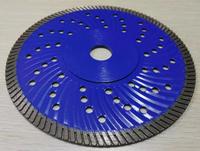
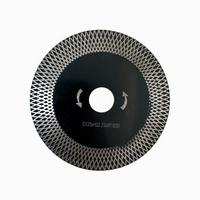
For the cutting, the diamond saw blade category covers the options. A thin panel and rock cutting blade suits dense panels, and a porcelain tile blade covers the smaller cuts and openings.
Two related reads: cutting rock panels with thin blades, and 115 mm and 125 mm blades for angle grinders.
Safety
Working at height with a cutting tool combines fall risk, dust, and noise. Use the scaffold or platform as designed, tether tools, wear a face shield and hearing protection, and use respiratory protection appropriate to the dust. Keep the guard fitted, and never cut with the blade above shoulder height on a hand-held saw.
If you are specifying tooling for a cladding project, send the panel type and thickness and we will confirm the blade and hole saw combination.