ES
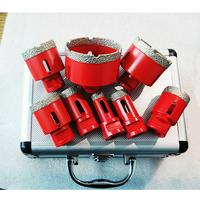
Two settings decide whether a diamond router bit cuts granite or polishes it: spindle speed and feed rate. Get them right and the segment stays sharp. Get them wrong and the bit glazes, the profile burns, and the operator spends the afternoon dressing a tool that should have lasted weeks.
The relationship that matters
What the segment actually experiences is a combination of surface speed at the cutting edge and the thickness of material each pass removes. Spindle speed sets the first; feed rate and depth of cut set the second.
If the feed is too low for the speed, the diamond rubs instead of cutting. The matrix does not wear, the diamonds blunt in place, and the tool glazes. If the feed is too high, the segment is overloaded, the machine deflects, and segments can crack or shear off.
Why there is no universal number
Feed and speed depend on the tool diameter, the segment bond, the granite's mineralogy, the machine's rigidity, and the depth of cut. A number copied from another shop is a starting point at best.
Granite varies more than its name suggests. A fine-grained black granite cuts differently from a coarse-grained grey, and a granite with a high quartz content wears bond faster than one dominated by feldspar.
Setting a starting point
Begin conservative: moderate spindle speed, a light depth of cut, and a feed that produces visible chips rather than dust. Run a short pass on an offcut and listen.
- Steady sound, free-cutting chips: close to correct.
- High-pitched squeal, fine dust: rubbing. Increase feed or reduce speed.
- Laboured motor note, vibration: overloaded. Reduce depth of cut first, then feed.
- Sparks or a burning smell: stop. The segment is overheating and the bond is being damaged.
Depth of cut
Multiple light passes almost always beat one heavy pass on granite. A heavy pass deflects the tool, which changes the effective feed at the cutting edge and produces a profile that is off-size.
On a profiling operation, rough with a light depth and finish with a spring pass at the same setting. The spring pass removes deflection error without loading the segment.
Adapting to the machine
A heavy, rigid machine tolerates higher feed than a light one. If the machine has a load meter, use it: a stable load at a given feed is a sign the cut is consistent, and a fluctuating load suggests the tool is skipping or the material is varying.
Watch the ammeter during the first piece of a new batch. A load that climbs through the cut usually means the tool is rubbing, not cutting.
Common mistakes
- Copying parameters from a different machine or a different granite.
- Reducing feed to improve finish. On diamond tooling, too low a feed makes the finish worse.
- Running a full depth in one pass to save time.
- Ignoring a change in sound because the first piece looked fine.
- Changing speed and feed at the same time, so you cannot tell which change helped.
Tooling
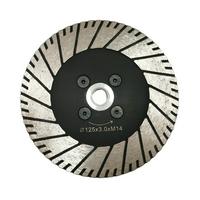
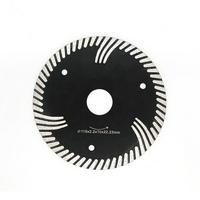
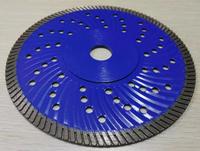
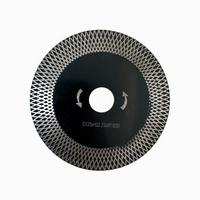
Start from the grinding disc category. A vacuum brazed milling and profile wheel is the usual CNC tool, and a 75 mm hand profile wheel covers touch-up work where a CNC pass is not practical.
Two related reads: maintaining router bits, and matching rpm ratings to tooling.
Safety
Keep the machine enclosure closed and the interlock functional. Wear eye protection and hearing protection. Never clear chips by hand near a spinning tool, and isolate the machine before changing a bit. Granite dust contains crystalline silica; use the machine's extraction and a respirator where exposure is possible.
If you are setting parameters for a new granite or a new profile, send the tool diameter, segment specification, and machine details and we will suggest a starting range.