ES
PCD tooling solves a specific problem: removing a coating from concrete without removing the concrete underneath. Used on the wrong surface it does the opposite of what the operator wants — it polishes the floor and burns the cutter.
What PCD actually is
PCD stands for polycrystalline diamond. Instead of diamond grit held in a metal matrix, a PCD cutter is a thin disc of sintered diamond on a carbide backing, brazed to the tool body. The cutting action is a shearing scrape rather than an abrasive grind.
That geometry is why PCD cuts epoxy, glue, mastic, and thin-set efficiently: the coating is brittle or semi-rigid, and a sharp edge shears it off the substrate. Concrete, by contrast, is abrasive and homogeneous — a PCD edge has nothing to catch, so it slides and heats up.
Where PCD earns its cost
- Epoxy coatings on warehouse and garage floors, including high-build and self-levelling types.
- Carpet and vinyl adhesive, especially the hard, old, black mastic that clogs abrasive tooling.
- Thin-set and mortar ridges after tile removal, where the mortar sits proud of the slab.
- Paint and elastomeric coatings that would gum up a diamond shoe.
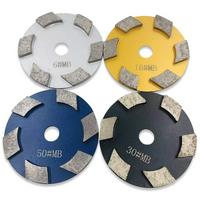
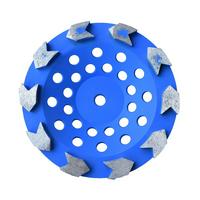
On a floor with both coating and level issues, a combination tool — PCD cutters plus diamond segments on the same plate — removes the coating and starts levelling in one pass. That arrangement is common on renovation work where time on site matters more than tooling cost.
Why PCD glazes on bare concrete
Bare concrete has no edge for the cutter to bite. The PCD face rides on the surface, friction rises, and the braze that holds the cutter can soften. Operators then add downforce, which accelerates the problem.
If you need to grind concrete, switch to a diamond shoe. If you need to remove a coating that has already been mostly removed, a hybrid plate or a coarse diamond shoe is the better finishing tool.
Adhesive is the difficult case
Old adhesive softens with heat. A PCD cutter run too fast or with too much pressure will smear it into a sticky film that re-bonds to the floor as it cools. The result looks like the coating moved rather than came off.
The controls are speed and dwell: moderate rpm, keep the head moving, and let the cutter shear rather than rub. On very gummy adhesive, a light pass first to break the surface, then a second pass to lift the residue, works better than one heavy pass.
Dust extraction is not optional
PCD work generates a mix of coating dust and concrete fines. Some older coatings contain materials you do not want to breathe, and the concrete underneath contributes silica. A shroud with a suitable extractor and a respirator rated for the exposure is the baseline.
Where the coating may contain hazardous components — some industrial epoxies and older floor paints — get the coating identified before grinding. That is a client conversation, not an operator decision.
Common mistakes
- Using PCD to grind a bare slab, then wondering why the floor is polished and the cutter is blue.
- Running at full machine speed on adhesive, which melts it instead of lifting it.
- No extraction, so the cutter works through a bed of its own debris.
- Expecting a PCD pass to leave a coating-ready surface. It removes material; it does not profile concrete.
- Mixing PCD and diamond shoes on the same plate without checking balance.
Tooling selection
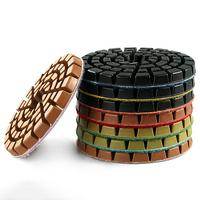
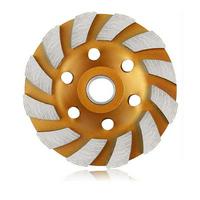
Start from the grinding disc category. A floor grinding block for coating removal handles the transition to bare concrete, and a resin filled cup wheel covers the light grinding and smoothing that follows.
Two related reads: removing epoxy with diamond grinding blocks, and resin filled versus metal bond cup wheels for the next step.
Safety
Wear eye protection, a respirator, hearing protection, and gloves. Keep the guard or shroud fitted, disconnect the machine before changing cutters, and check that cutters are seated and the plate is balanced. A PCD cutter that comes loose at speed is a projectile.
Send us the coating type, thickness, and substrate and we will confirm whether PCD, diamond, or a combination plate fits the job.