ES
Foundation work on wind and solar sites looks repetitive from a distance and is anything but up close. Turbine bases are mass pours with dense reinforcement and anchor assemblies; solar farm foundations vary with ground conditions and design. Both ask for core drilling that is deep, accurately positioned, and documented.
What the concrete is like
Mass concrete placements cure differently through their depth, and the aggregate can be large and hard. A core bit that behaves well in the upper section can slow markedly as it reaches a denser zone or the reinforcement cage. The rig needs torque reserve at the diameter being used and a mounting arrangement that will not creep during a long hole. The core drill stand and anchor guide covers the setup.
Depth is the second issue. Extension bars add joints, and every joint is a possible source of runout and water loss. The deep hole drilling guide describes how to keep alignment and cooling under control as the assembly grows.
Weather and access
Remote sites add wind, rain, and long travel between positions. Check the forecast before scheduling deep holes, keep water from freezing overnight, and protect the rig and records during transport. A partly drilled hole left overnight needs a clear marker and a note of the depth reached, so the next crew can resume without guessing where the bit stopped.
Planning the work on site
- Survey before drilling. Locate reinforcement, anchor bolts, conduits, and any embedded monitoring equipment.
- Confirm the core specification. Diameter, required length, and whether an intact core is needed for testing.
- Plan the water supply. Remote sites need a tank, a pump, and a containment route for slurry.
- Secure the power supply. Long leads and generator-fed circuits affect torque and require appropriate protection.
- Label every core. Position, depth, orientation, and date; an unlabelled core is of limited use later.
The reinforced concrete drilling guide explains the feed and cooling changes needed when steel is encountered, which is a routine part of this work rather than an exception.
Reading the return and the core
Slurry colour and consistency indicate when the bit crosses from one pour or layer into another; note the depth of each change. On retrieval, look for fractured sections that could indicate a void or a drilling problem rather than a material defect. Photograph the core in its tray with a scale and a label visible, so the engineer reviewing it has the context that a written description cannot provide.
Working across a spread site
On a wind or solar site the rig may move between foundations separated by long distances. Standardise the setup at each position: the same anchor method, water volume, extension order, and labelling format. Consistency makes the cores comparable and makes an unusual result stand out, rather than being explained away by a difference in how that particular hole was drilled.
Tooling and safe practice
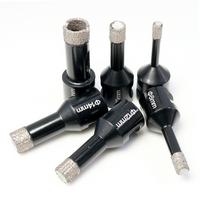
Browse the diamond drill bit category for diameter and segment options. A wide-diameter core bit suits foundation penetrations, and a sintered M14 core bit covers smaller investigative holes on the same site.
Anchor the rig before starting, keep cooling water flowing, and use an RCD-protected supply. Wear eye protection, hearing protection, and a respirator rated for the exposure, keep the guard fitted, and confirm rated rpm. Isolate the rig before changing a bit or adding an extension.