ES
Floor grinder tooling fails for boring reasons. The shoe does not fit the plate, the bond is wrong for the concrete, or the grit sequence skips a step. None of those problems show up until the floor is half finished and the scratch pattern will not come out.
Fitment comes before anything else
Grinding shoes mount to the machine's tool plate, and every major manufacturer uses a different pattern — three-hole, four-hole, keyed slots, magnetic plates. A shoe that does not seat flat will rock, and a rocking shoe produces an uneven floor plus a cracked segment.
Confirm the plate pattern and the shoe's fixing centres before ordering. Adapter plates exist, but each layer of adaptation adds runout, and runout at 700 rpm shows up as chatter marks across the whole floor.
Bond hardness against concrete hardness
The rule is counterintuitive at first: hard concrete needs a soft bond, and soft or abrasive concrete needs a hard bond.
On hard, dense concrete the diamonds blunt before the matrix wears away, so a softer matrix releases them. On soft, sandy, or heavily aggregate concrete the matrix erodes before the diamonds do, so a harder bond keeps them in place long enough to work. Getting this backwards produces either a glazed shoe that polishes instead of grinding, or a shoe that wears out in a few passes.
Test a square meter before committing. If the shoe glazes and the floor burns, go softer. If the shoe wears visibly within minutes, go harder.
Segment count and shape
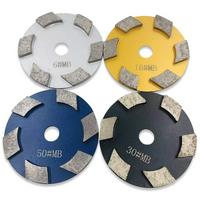
More segments spread over the same area means lighter pressure per segment and a finer scratch pattern. Fewer, taller segments cut more aggressively and clear debris better, which suits coating removal and heavy levelling.
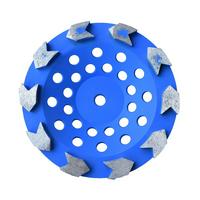
Segment shape matters at the edges of the plate: angled or arrow segments sweep material outward and reduce the ring of dust that collects under the machine. On a machine with a good shroud, the difference is mostly about how often the operator has to stop and clear the head.
Grit sequence
A working sequence for coating removal and levelling usually runs coarse to fine in steps of roughly double the grit: 16 or 20, then 30, then 60, then 120 if the surface will be polished or coated.
Skipping a step is the most common cause of a floor that looks fine wet and shows scratches under raking light. Each grit has to remove the previous scratch pattern completely, and that means overlapping passes in two directions.
Dry or wet
Most floor grinding is dry with dust extraction, because slurry management on a large floor is its own project. Wet grinding controls dust better and keeps the segment cooler on hard concrete, but the slurry has to be contained, and some coatings will not accept a wet-prepared surface without drying time.
Machine weight and head pressure
A lightweight single-head grinder cannot do the work of a heavy planetary machine on the same grit. Adding weight helps up to a point; beyond that the motor bogs and the segments overheat.
Match the grit to the machine's capability. A 30-grit shoe on a light machine will skate. The same shoe on a heavy planetary machine cuts properly. That is why borrowing a grit recommendation from another contractor often disappoints.
Common mistakes
- Ordering shoes by grit without checking plate fitment.
- Running a hard bond on hard concrete, then blaming the machine for glazing.
- Mixing grits on the same plate. All shoes on a plate must match, or the head runs out of balance.
- Grinding dry with no extraction and letting dust pack the segments.
- Judging the finish under diffuse light instead of raking light.
Tooling and specification
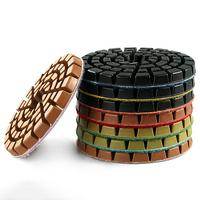
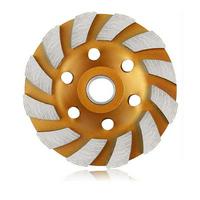
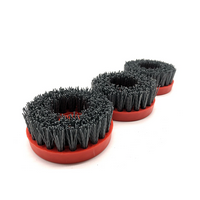
Start from the grinding disc category. A diamond floor grinding block covers general levelling and coating removal, while an arrow segment grinding disc suits heavier stock removal on cured concrete.
Two related reads: concrete floor preparation tools for how grinding fits into a full sequence, and bond hardness explained for the underlying mechanism.
Safety
Floor grinders are heavy and generate silica dust. Use a shroud with a suitable extractor, a respirator rated for the exposure, hearing protection, and eye protection. Keep hands and clothing clear of the rotating head, disconnect power before changing shoes, and never lift a running machine onto its edge to inspect the segments.
If you are specifying tooling for a floor program, send the concrete hardness, coating type, and machine model and we will confirm bond and grit.