ES
Two floor grinders can carry the same diamond grit and produce completely different results on the same slab. One leaves a flat, consistent scratch pattern; the other polishes the high spots and skips the low ones. The difference usually comes down to machine weight and how many heads are sharing the load.
Weight is a process variable
Diamond needs pressure to fracture and expose fresh grit. On a planetary grinder, much of that pressure comes from the machine itself rather than the operator, which is why adding weight changes the cut rate and the speed at which the bond wears. A light machine with a hard bond may simply glide over dense concrete without ever opening the segment.
More weight is not automatically better. Excessive pressure on a soft bond can strip the matrix before the diamond has done its work, and on a weak or hollow slab it can expose near-surface defects. The bond hardness should be matched to the aggregate and to the pressure the machine actually applies; the bond matrix explainer covers that relationship.
Head count and scratch pattern
A single-head machine concentrates all the force in one small contact area and leaves a pronounced circular pattern. Multi-head planetary machines distribute the same mass across several discs rotating in opposing directions, which produces a flatter, more uniform scratch pattern and reduces the amount of cross-hatching needed later.
Head count also changes what happens at edges. More heads usually mean a wider machine and a larger unground strip along walls and columns, so edge work with a smaller tool remains part of the job. Our note on surface profile and tool selection ties the required profile to the tooling sequence rather than to the machine alone.
Coverage and overlap
Pass spacing should be set so that each new run overlaps the previous one by a meaningful margin. On a wide planetary head, overlapping by roughly a third of the working width avoids the ridges that show up later under a high-gloss finish. Rushing the coverage to finish the area is the most common cause of a floor that looks acceptable after grinding but bands badly after densifier and polish.
Power, dust, and the rest of the setup
- Supply. Larger machines need three-phase power or a dedicated circuit. An undersized supply shows up as voltage drop, heat, and inconsistent head speed.
- Dust extraction. The shroud and extractor have to keep pace with the number of heads. A machine with more contact area generates fines faster than a single-head unit.
- Transport. Removable weights make a heavy machine usable on upper floors and in lifts, but each change alters the cut and should be followed by a test patch.
- Test patch. A one-square-metre trial with the intended tooling settles bond choice, pass count, and expected profile before the whole slab is committed.
Matching tooling to the machine
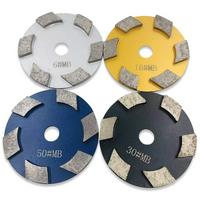
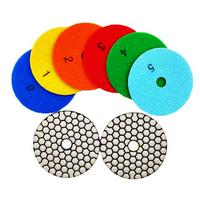
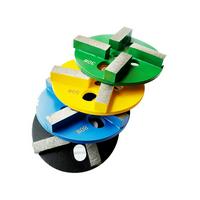
For heavy planetary work, diamond floor grinding blocks are made for the holders and pressures these machines use. On lighter machines or for aggressive stock removal, an arrow-segment grinding disc can open the surface with less dependence on machine mass. The transition from metal bond to resin bond is the point where machine weight matters less and scratch refinement matters more.
Browse the grinding tools category if you are matching holders as well as discs. Keep dust control in place on every pass, wear eye protection and hearing protection, isolate the machine before changing tooling, and check rated rpm on each disc against the head speed.